TCP Shield
TCP Shield allows you to offer DDoS protection services to your clients. This module integrates with Blesta to automate the provisioning and management of TCP Shield services. Everything you need
From £19.99 - View Pricing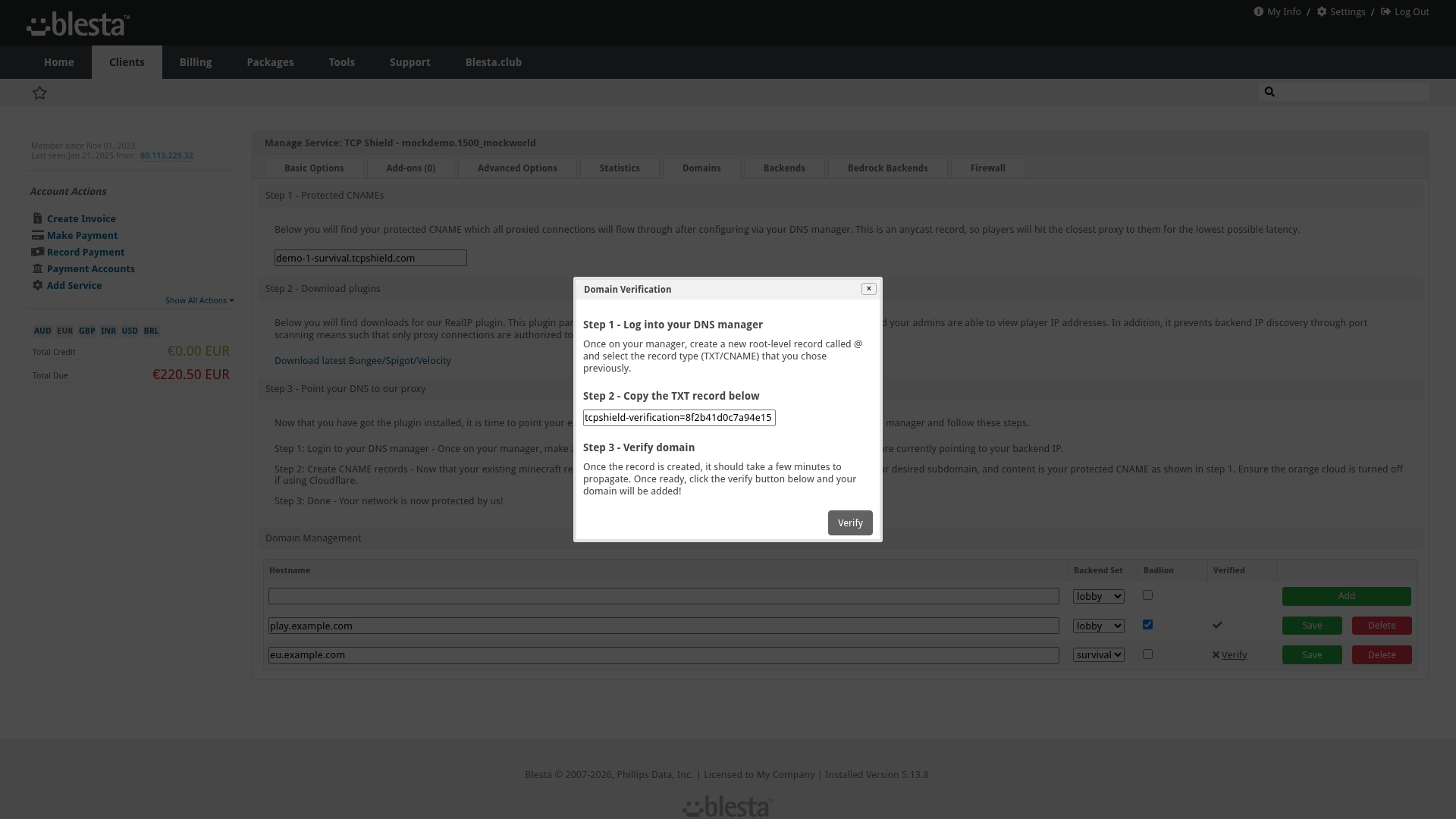
Features
What TCP Shield gives you
Staff and Client Area
Gives both your staff and your clients a purpose-built interface in their own area of Blesta.
Rename Propagation
Renaming the service in Blesta renames the network at TCPShield too, so the two never drift apart.
Per-Company Configuration
Configure it independently for each brand on a multi-company install, so every company runs with its own settings.
Firewall Rules
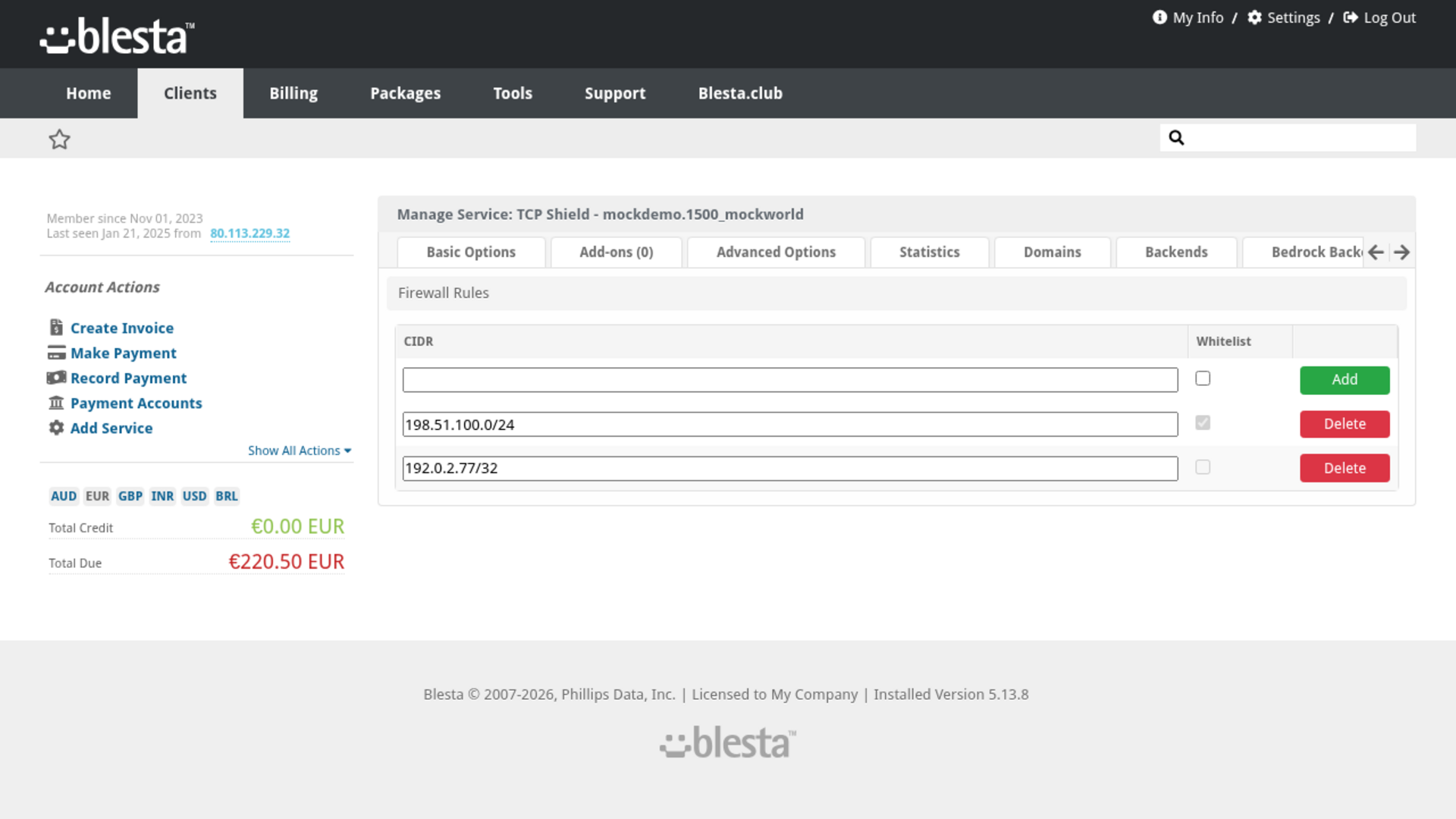
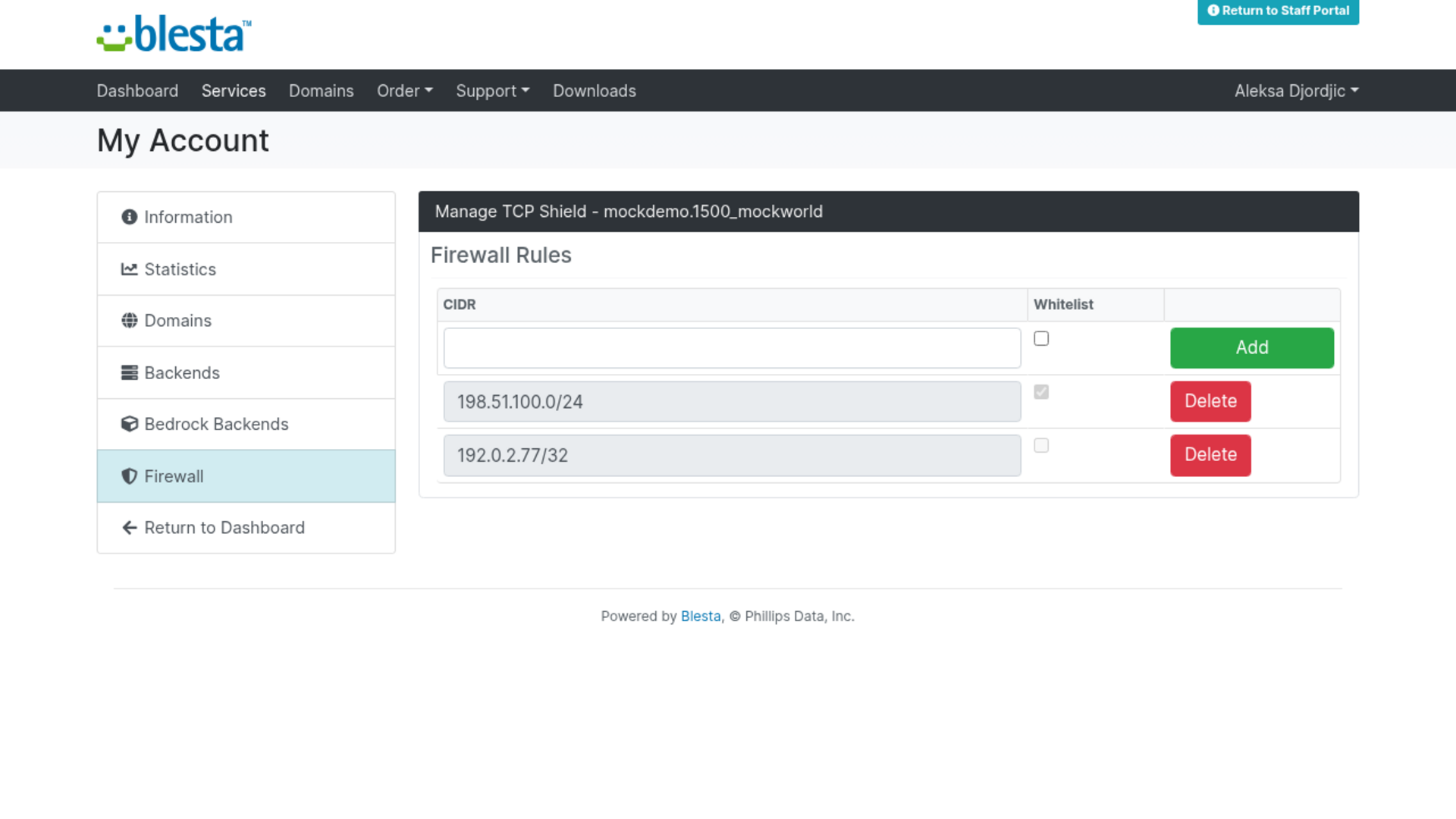
Clients add and remove CIDR firewall rules with a whitelist toggle, keeping unwanted networks away from their servers.
Fully Translatable
Every staff and client label ships in editable language files, ready to translate into any language or reword to match your brand.
Player and Bandwidth Statistics
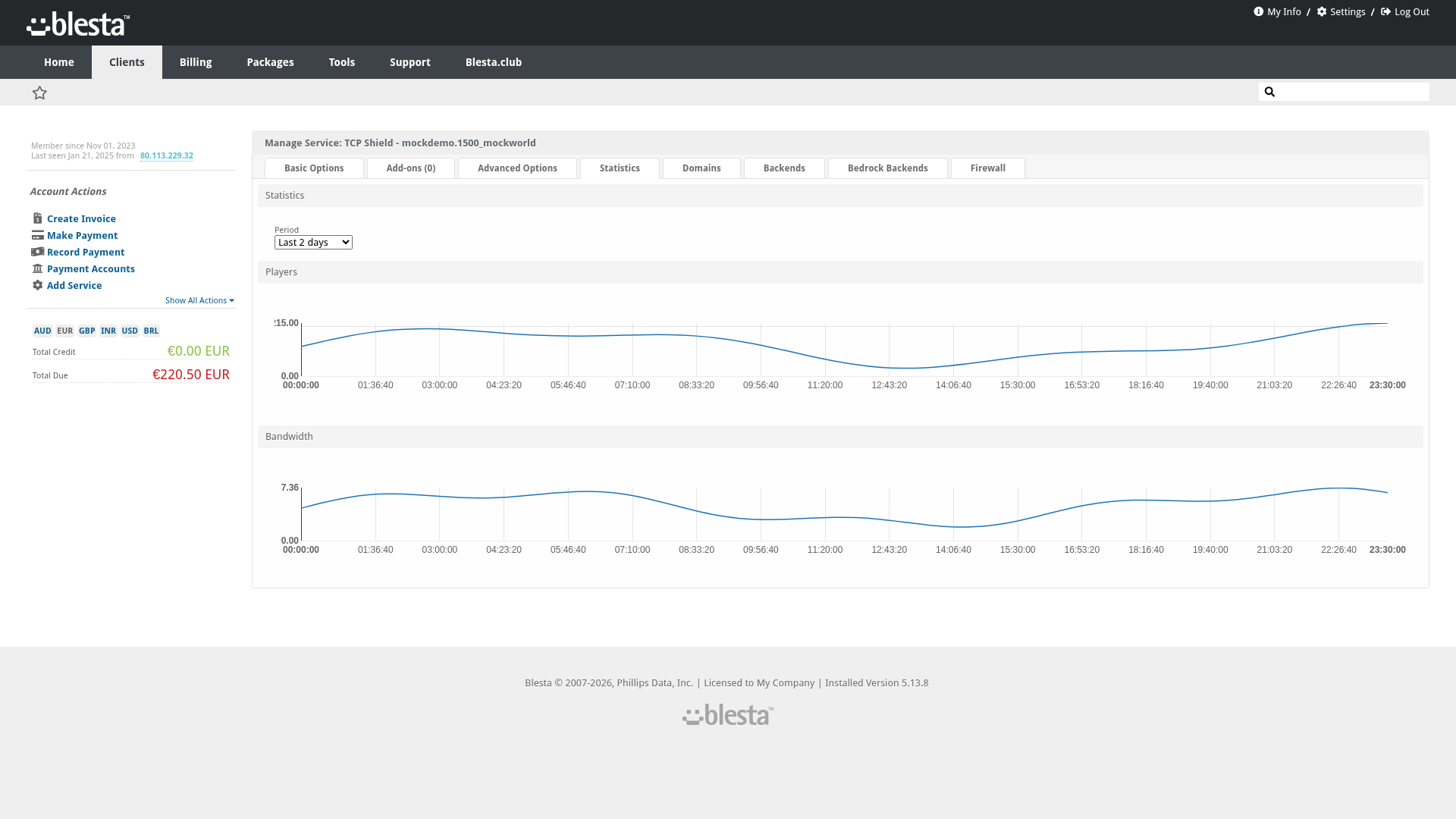
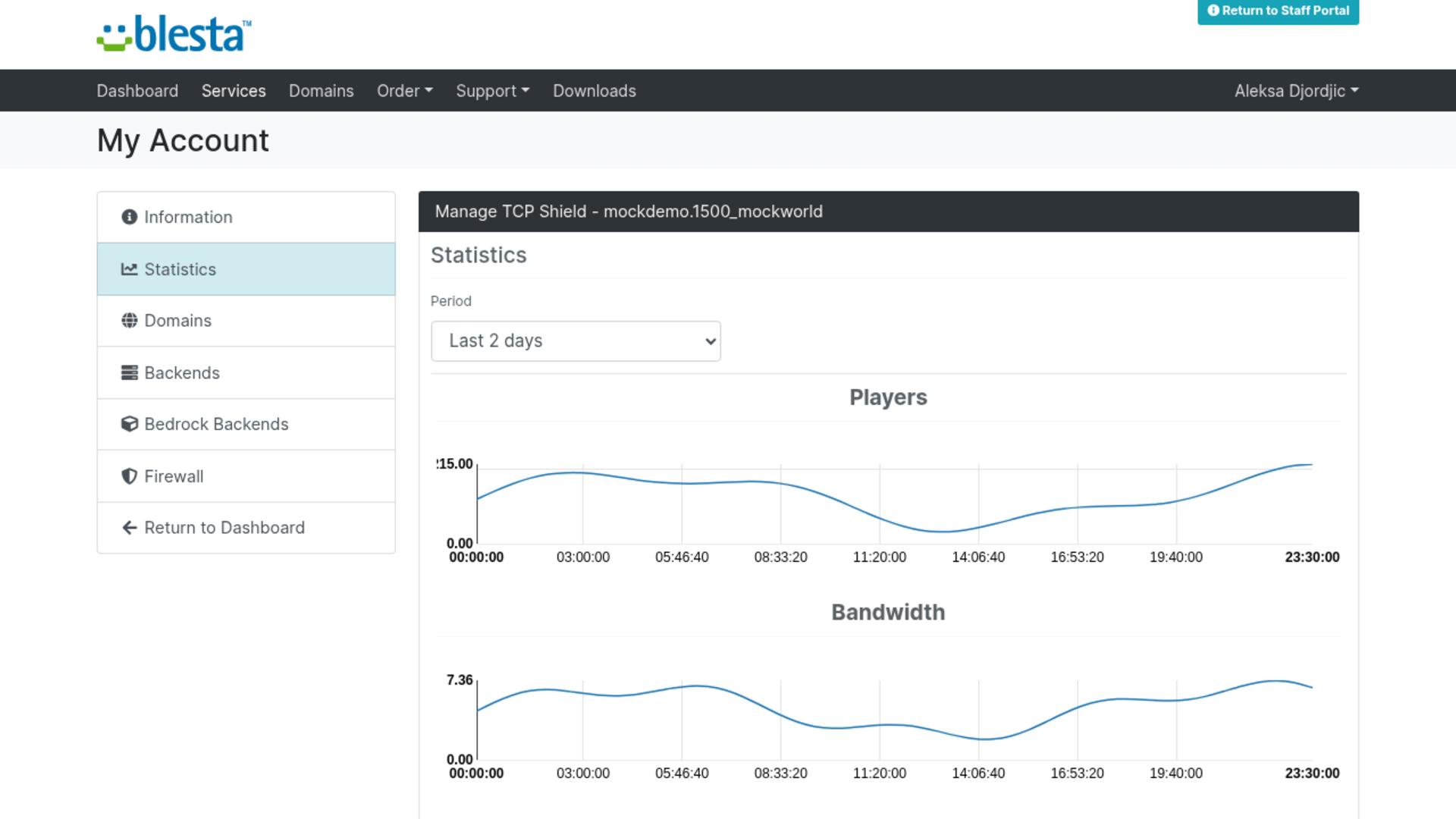
Charted player counts and bandwidth for the last 24 hours, 2 days, or 7 days, so clients can see their traffic and you can see theirs.
Bedrock Tunnel Management
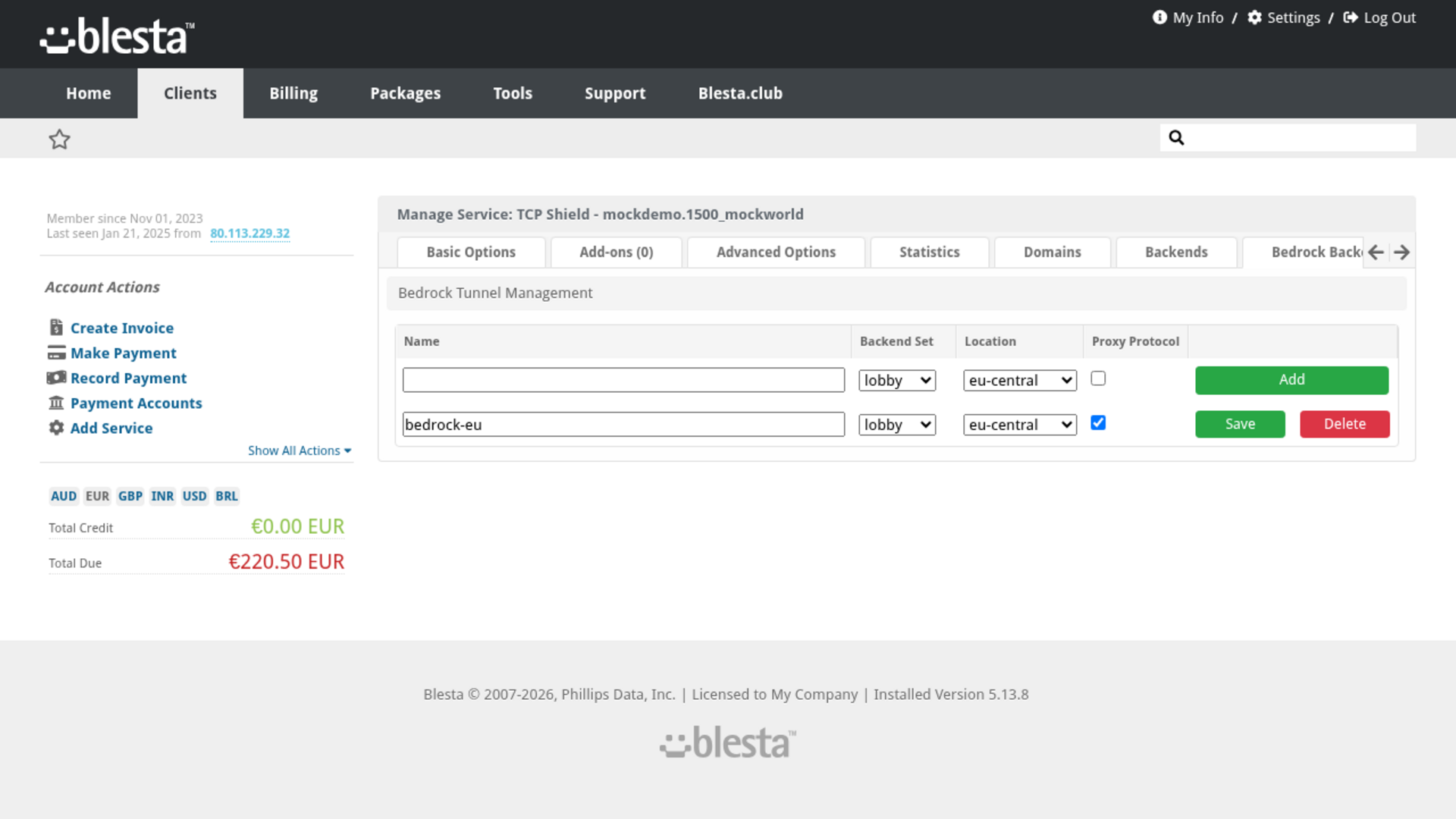
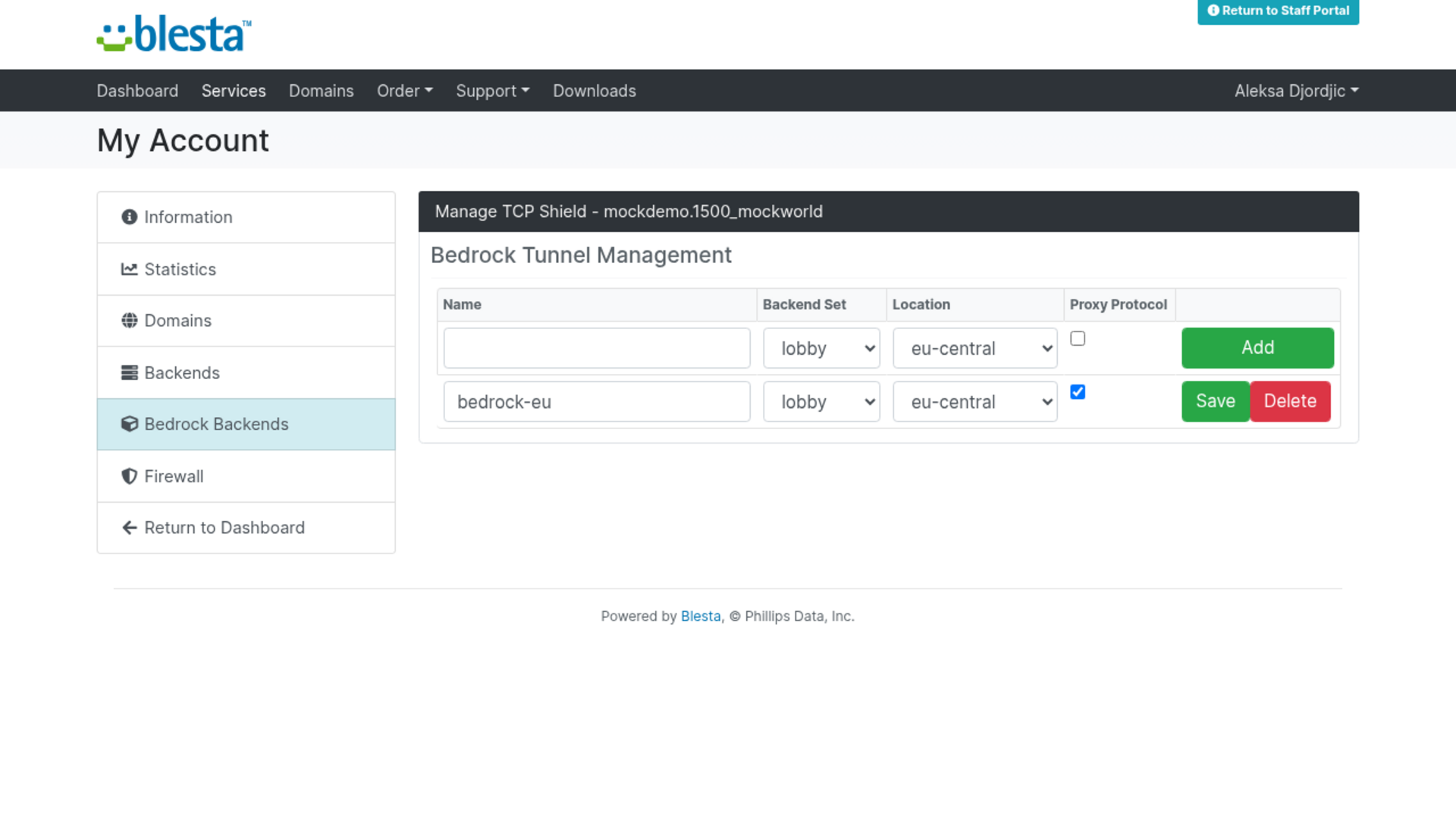
Bedrock players are covered too - clients create tunnels with their own name, backend set, location, and proxy protocol from a dedicated tab.
Built-In Demo Mode
A built-in demo mode runs the whole extension from bundled sample data, so you can trial every screen and action before you have an account or API key.
Staff Mirror of Every Tab
Your team gets the same Domains, Backends, Bedrock, Firewall, and Statistics tabs on the staff side of the service, so support can fix a client's setup for them.
Suspension Without Data Loss
Suspending a service silently neutralises the client's backends instead of deleting their configuration, and reactivating restores every backend exactly as it was.
Backend Set Management
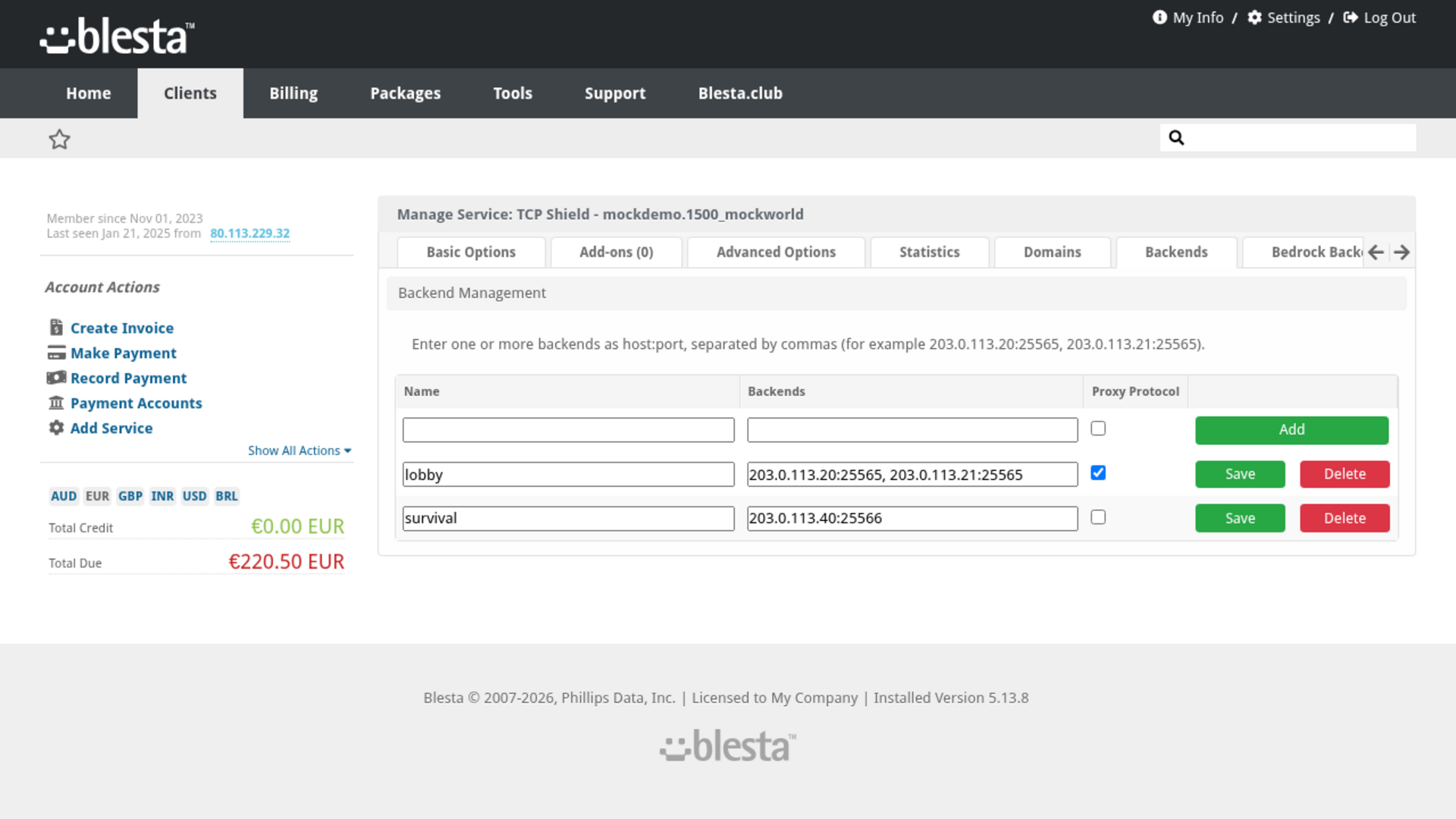
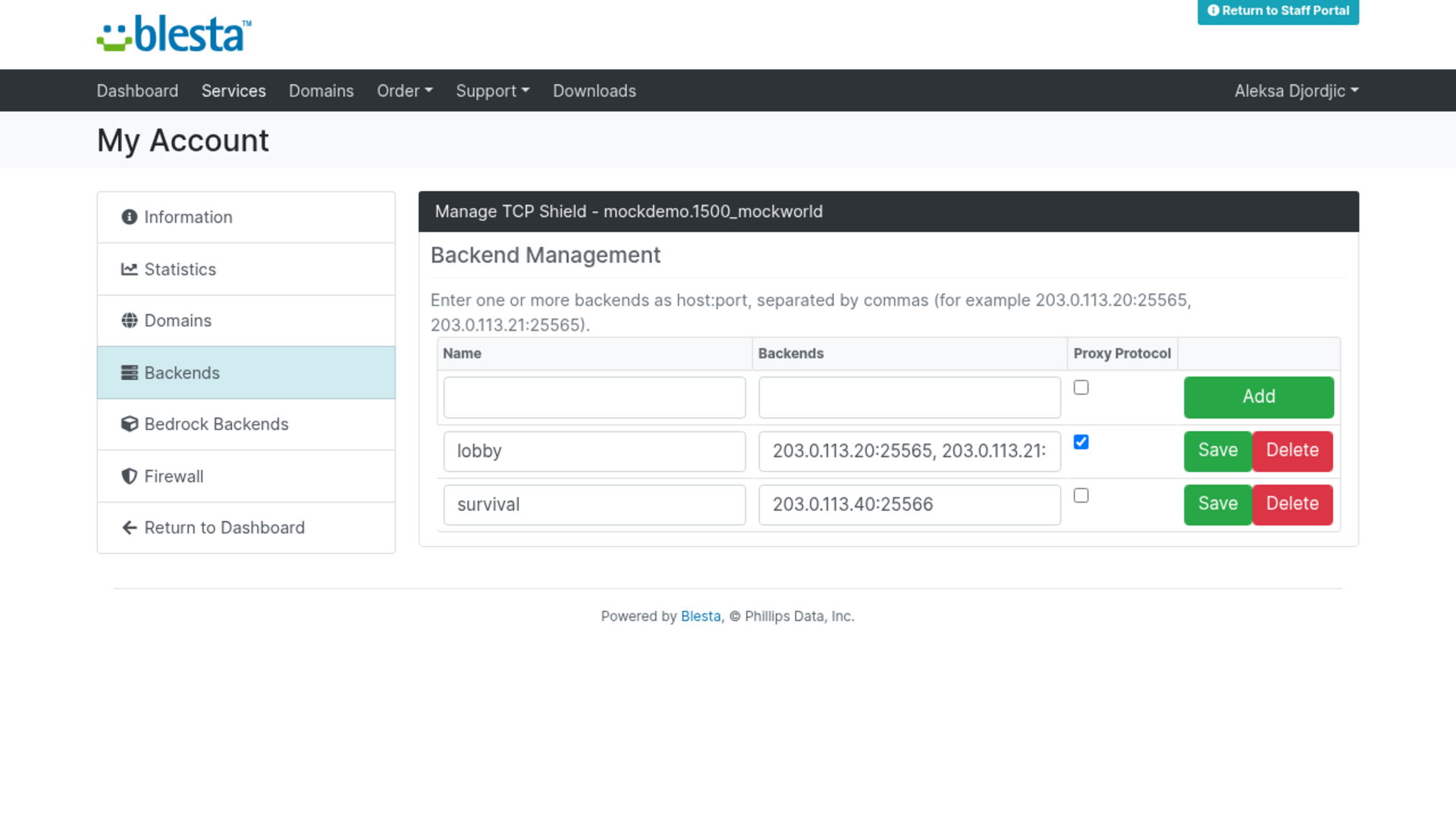
Clients create and edit backend sets with their own backend addresses and proxy protocol setting, so they can repoint traffic themselves whenever their servers move.
Per-Package Limits
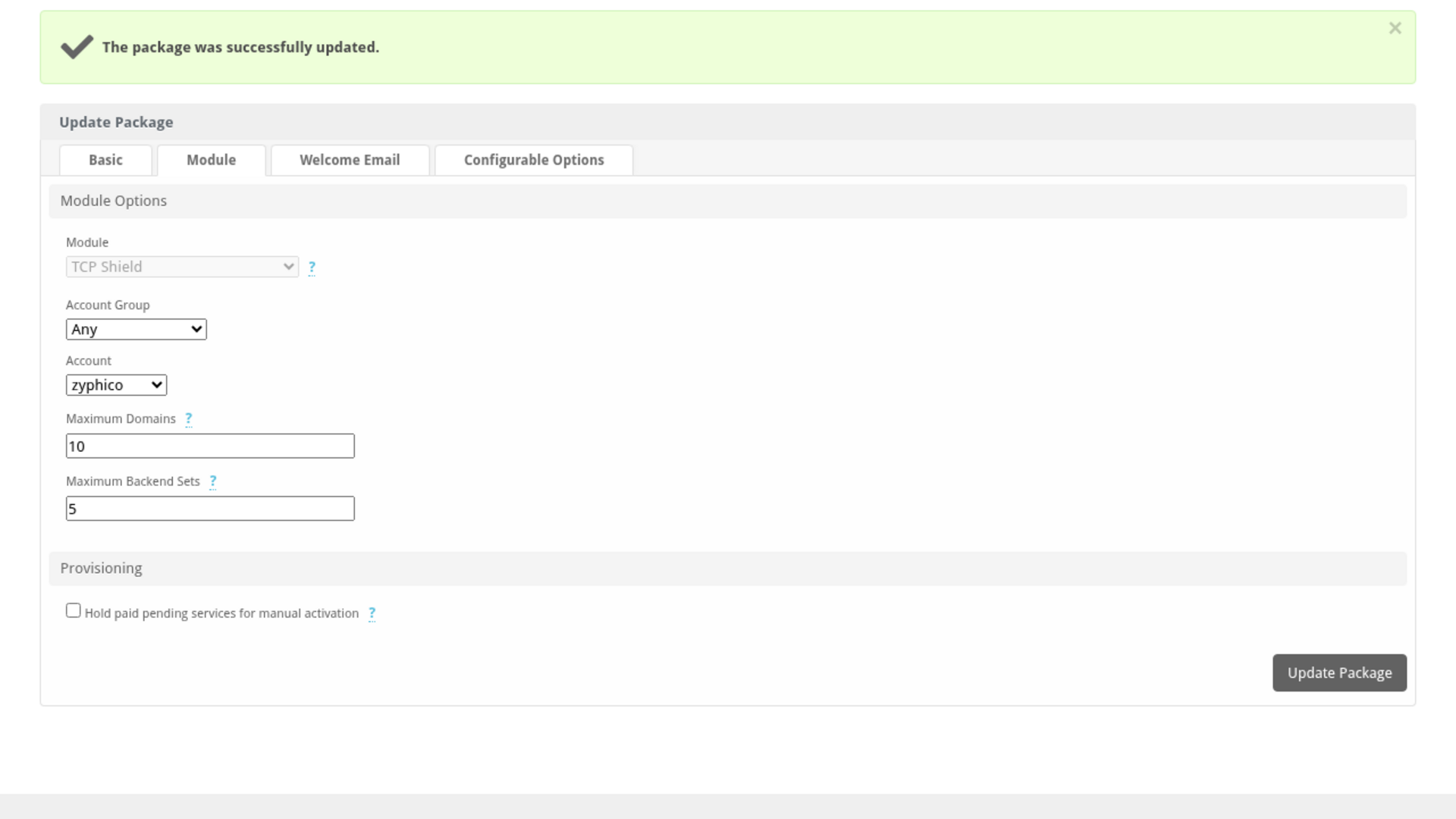
Cap how many domains and how many backend sets a package allows, and the limit is enforced when the client tries to add another. Leave either blank or 0 for unlimited.
Domain Management with Verification
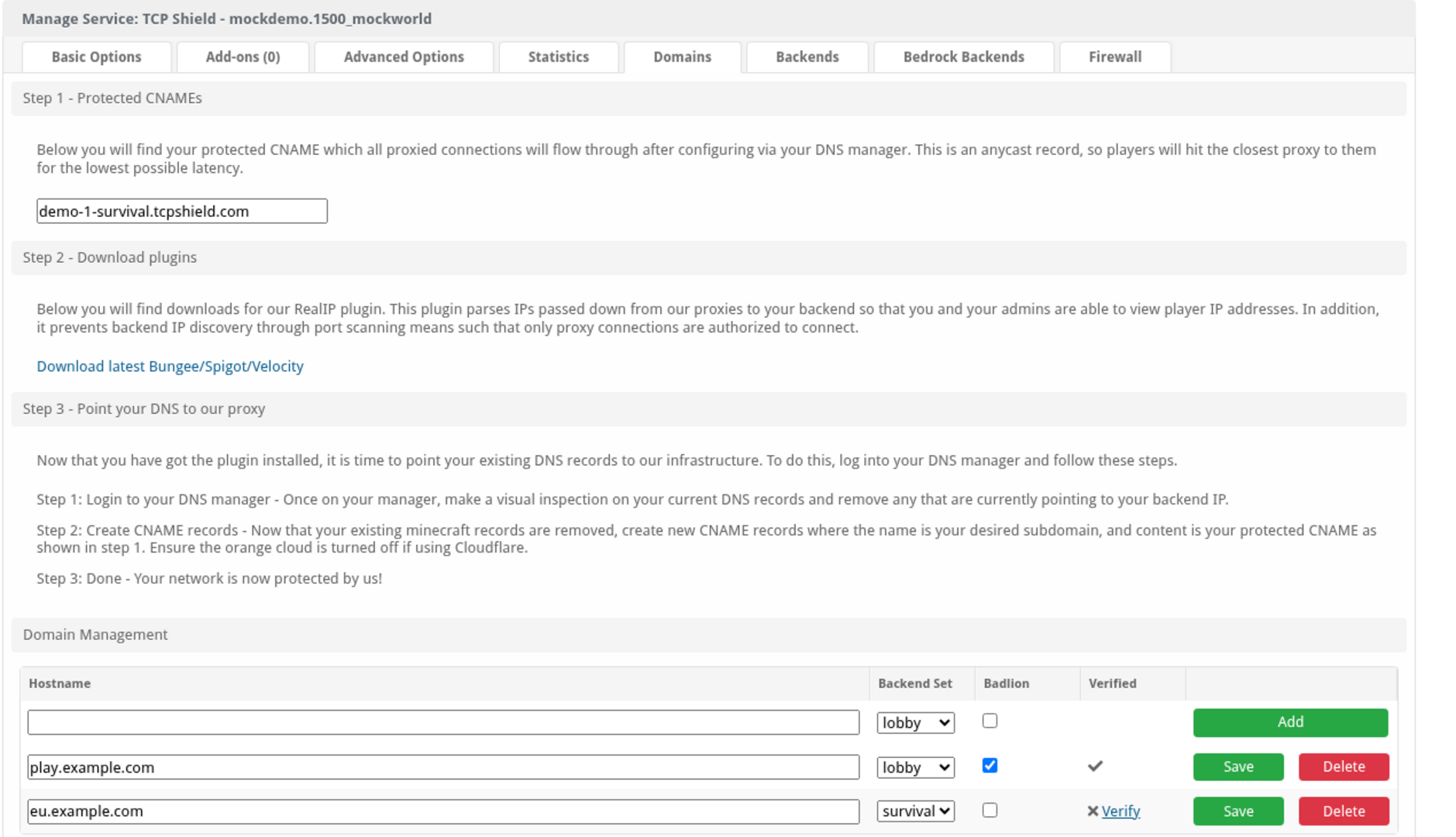
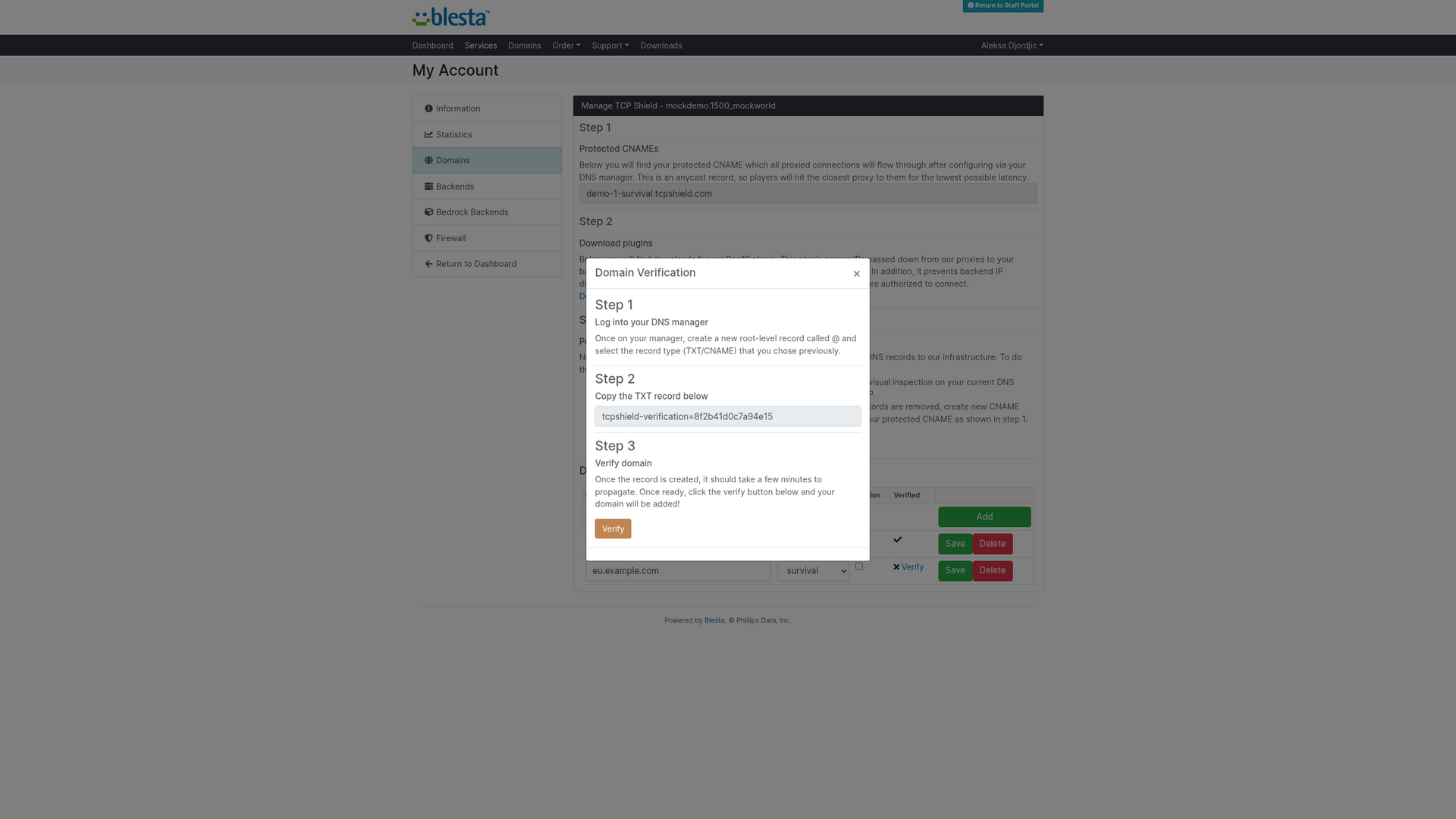
Clients add, edit, and remove their own domains, assign each to a backend set, toggle Badlion support, and prove ownership through a guided TXT-record verification flow built into the tab.
Guided Setup for Clients
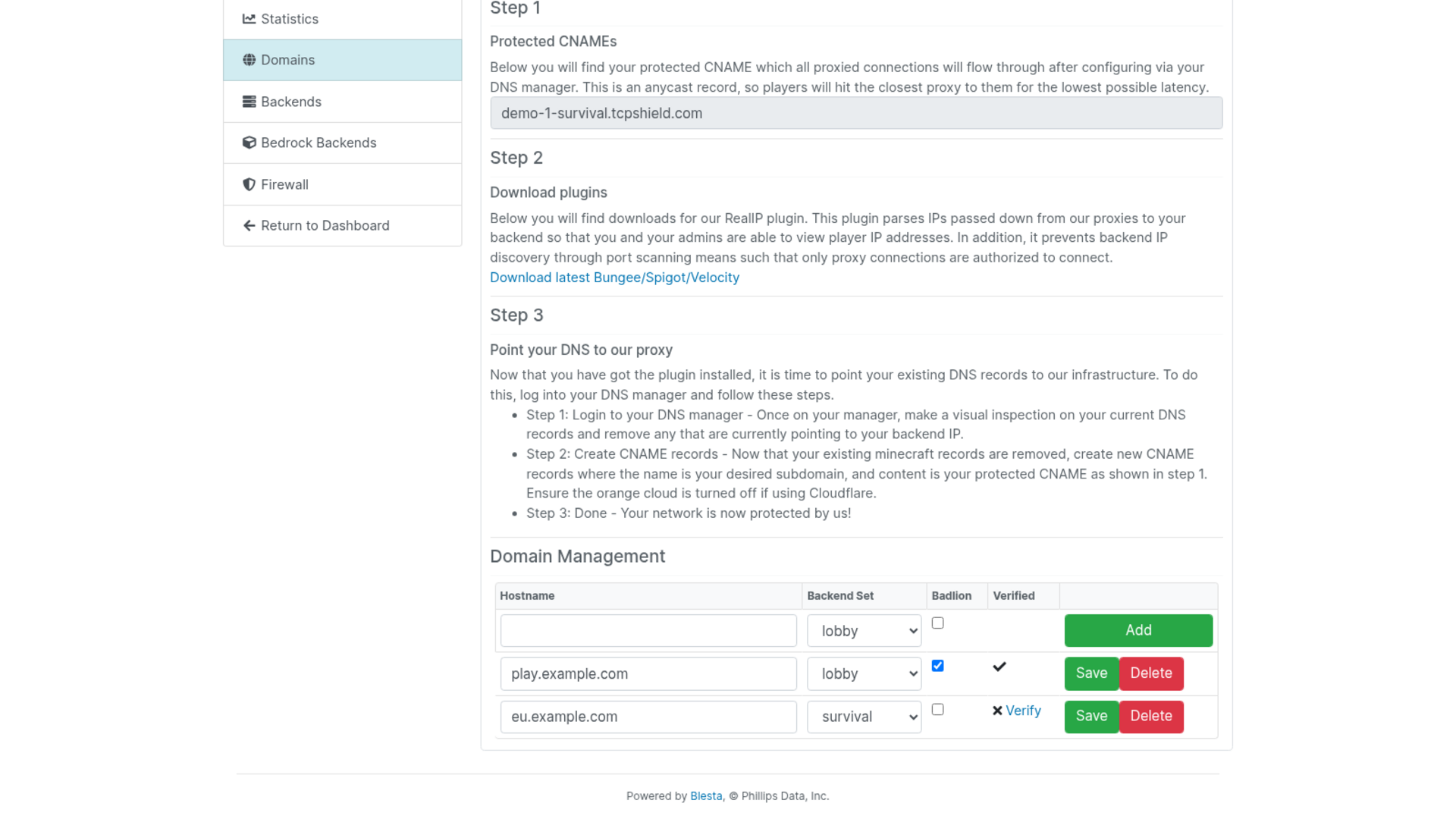
The Domains tab walks the client through the whole onboarding - their protected anycast CNAME, the RealIP plugin download for Bungee, Spigot, and Velocity, and the exact DNS records to create - so a new customer gets protected without opening a ticket.
Automatic Network Provisioning
A paid order creates the client's TCPShield network and stores its protected CNAME against the service, so protection is live the moment they pay. Every network is named with your own prefix, keeping one TCPShield account tidy across hundreds of clients.

TCP Shield
Resell TCPShield DDoS protection for Minecraft, with a self-service panel where clients run their own domains, backends, Bedrock tunnels, and firewall rules.
What it does
A Minecraft server is an easy DDoS target, and most hosts either build their own protection or leave clients to sort it out themselves. The TCP Shield module orders a protected TCPShield network the moment a client's service goes active, then gives them a full self-service panel to manage it - so protection is live at checkout and your support team isn't the one configuring DNS records for every order.
Key features
- Automatic Network Provisioning: A paid order creates the client's TCPShield network and stores its protected CNAME against the service, so protection is live the moment they pay.
- Guided Client Onboarding: The Domains tab walks a new client through their protected CNAME, the RealIP plugin download, and the exact DNS records to create, so they get protected without opening a support ticket.
- Domain Verification: Clients add, edit, and remove their own domains, assign each to a backend set, and prove ownership through a guided TXT-record verification flow built into the tab.
- Backend & Bedrock Management: Clients manage their own backend sets and Bedrock tunnels, so they can repoint traffic themselves whenever their servers move.
- Firewall Rules: Clients add and remove CIDR firewall rules with a whitelist toggle, keeping unwanted networks away from their servers.
- Player & Bandwidth Statistics: Charted player counts and bandwidth over the last 24 hours, 2 days, or 7 days, so both you and your client can see their traffic.
- Staff Mirror of Every Tab: Your team gets the same Domains, Backends, Bedrock, Firewall, and Statistics tabs on the staff side, so support can fix a client's setup for them without leaving Blesta.
- Per-Package Limits & Mock API Mode: Cap how many domains and backend sets a package allows, and try the whole module end to end with bundled sample data before you ever enter a TCPShield API key.
Installing and updating extensions can now be done automatically through the Blesta Club Subscription Manager - this is the recommended way going forward.
Installing TCP Shield
Before you start
- Version 3.x requires Blesta 6.0 or later. On a Blesta 5 install, use version 2.x instead.
- If you are on the leased (subscription) licence, the Blesta Club Subscription Manager must be installed and your subscription active. The owned and owned-source licences have no such requirement.
- You will need a TCPShield API key from your TCPShield account. If you just want to try the module out first, you don't need one at all - a built-in Mock API mode lets you test every screen with bundled sample data instead of a live account.
1. Upload the files
Upload the extension folder into your Blesta installation so it lands under your Blesta directory at:
components/modules/tcp_shield/For example, on a typical install: /var/www/html/blesta/components/modules/tcp_shield/
2. Install it in Blesta
- Log in to your Blesta admin area with a staff account that has the Modules permission (under Settings in Manage Staff Groups), including its Install Module sub-permission.
- Go to Settings > Company > Modules and click the Available tab.
- Find TCP Shield in the list and click Install.
3. Configure it
- Go to Settings > Company > Modules, find TCP Shield in the Installed list, and click Manage.
- Click Add Account to add a TCPShield account:
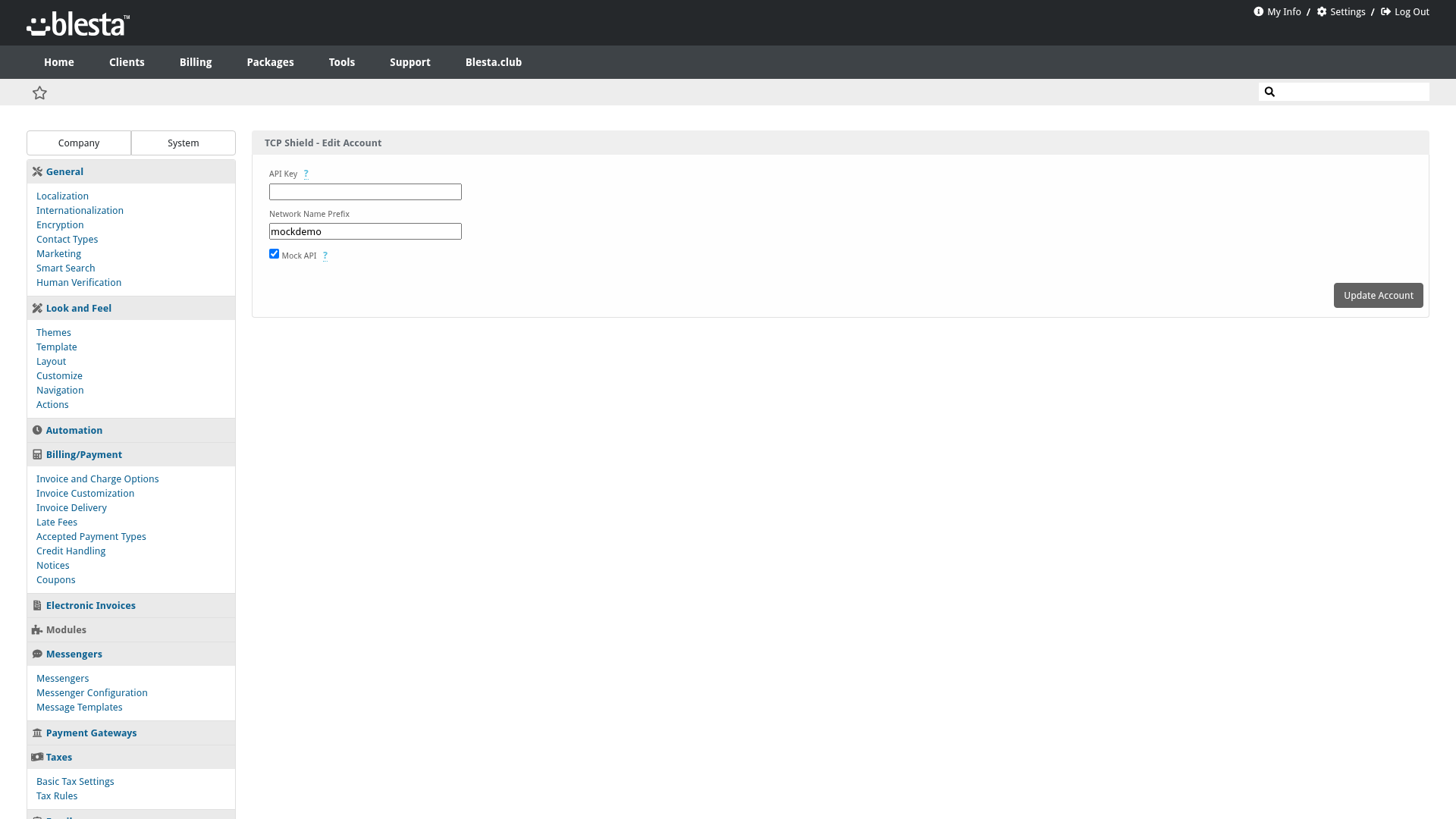
- Enter a Network Name Prefix - this is prepended to every network TCP Shield creates for a client, so one TCPShield account stays tidy across many customers.
- Enter your TCPShield API Key. If you want to test or demo the module first, leave the key blank and tick Mock API instead - every request is then served from bundled sample data and nothing is created or changed at TCPShield.
- Save the account.
- Create or edit a package that uses the TCP Shield module and this account. On its Module tab you can optionally cap the Maximum Domains and Maximum Backend Sets a client on this package may add - leave either blank or 0 for unlimited.
You're ready to go - see the usage guide for a walkthrough of day-to-day use.
Installing and updating extensions can now be done automatically through the Blesta Club Subscription Manager - this is the recommended way going forward.
Updating TCP Shield
Upgrading works just like installing: upload the new files over the old ones, then run the upgrade from the same page you installed it on.
- Back up your current extension files first - good practice before any upgrade.
- Upload the new version over the existing folder, replacing the old files.
- Log in to your Blesta admin area and go to Settings > Company > Modules.
- Find TCP Shield and click Upgrade to run the upgrade.
Version-specific notes
- v3.0.0: Requires Blesta 6.0 or later - upgrade Blesta first, then the module. Blesta 5 installs should stay on 2.x. Nothing changes in your accounts, packages or services; the staff screens take on the Blesta 6 admin theme (light and dark), the Edit and Delete links on the account list become buttons, the Add/Edit Account forms gain a Back button, and a delete in the staff Domains, Backends, Bedrock Backends and Firewall tabs confirms with the Blesta 6 dialog. The client area is unchanged.
- v2.0.0: Re-save each TCPShield account after upgrading. Earlier versions stored the account API key in plain text and used it as the account's display key; both are fixed on save, but an existing account keeps its plaintext key until it is saved again. The Network ID field is now admin-only and no longer accepted from a client order or service edit. Staff also get a full mirror of the client's Domains, Backends, Bedrock Backends, Firewall, and Statistics tabs on the service page, and packages can optionally cap how many domains and backend sets a client may add - both appear automatically, there is nothing to enable.
- v1.1.0: A new Mock API checkbox is available on each account for testing and demos. Account API keys are now stored encrypted and masked on the manage page - this happens automatically the next time you save an account, nothing to do beforehand.
This upgrade is otherwise drop-in - no data migration is required for any of the above.
Using TCP Shield
For your staff
Managing TCP Shield accounts
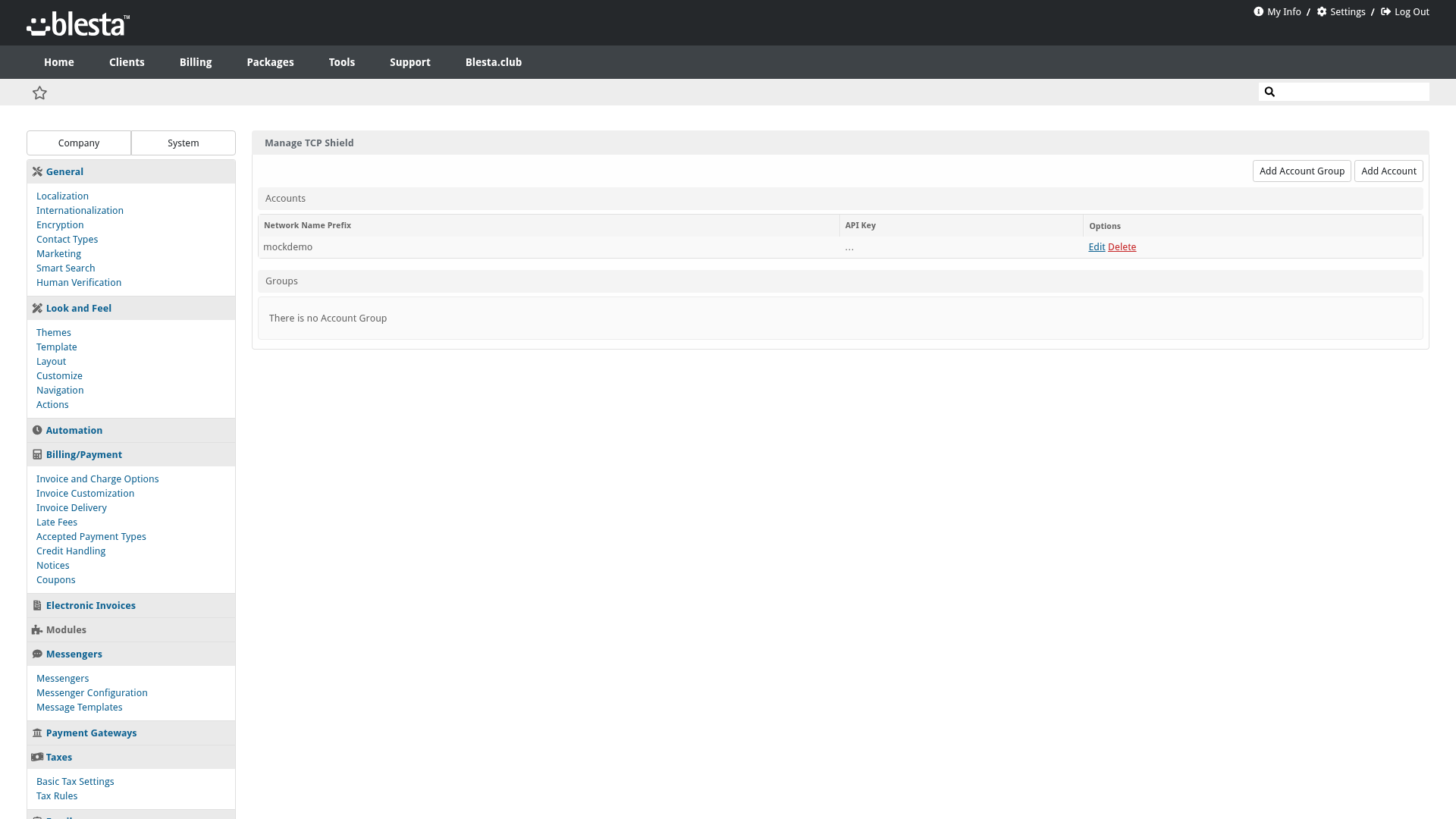
Go to Settings > Company > Modules, open TCP Shield's Manage page, and you'll see your Accounts table (each one a TCPShield API key and its Network Name Prefix, or a Mock API account for testing) and any Account Groups you've created to pool multiple accounts together. Click the pencil button next to an account to change its name prefix, replace its API key, or toggle Mock API - leaving the API Key field blank on save keeps whatever key is already stored, it is never cleared by accident - and the trash button to remove it after a confirmation. Click Add Account to add another one; both account forms have a Back button that returns you to this list.
Setting up a package
On a package that uses the TCP Shield module, its Module tab lets you optionally set Maximum Domains and Maximum Backend Sets - the number of each a client on this package may add themselves. Leave either blank or 0 for unlimited.
What happens when a service is ordered
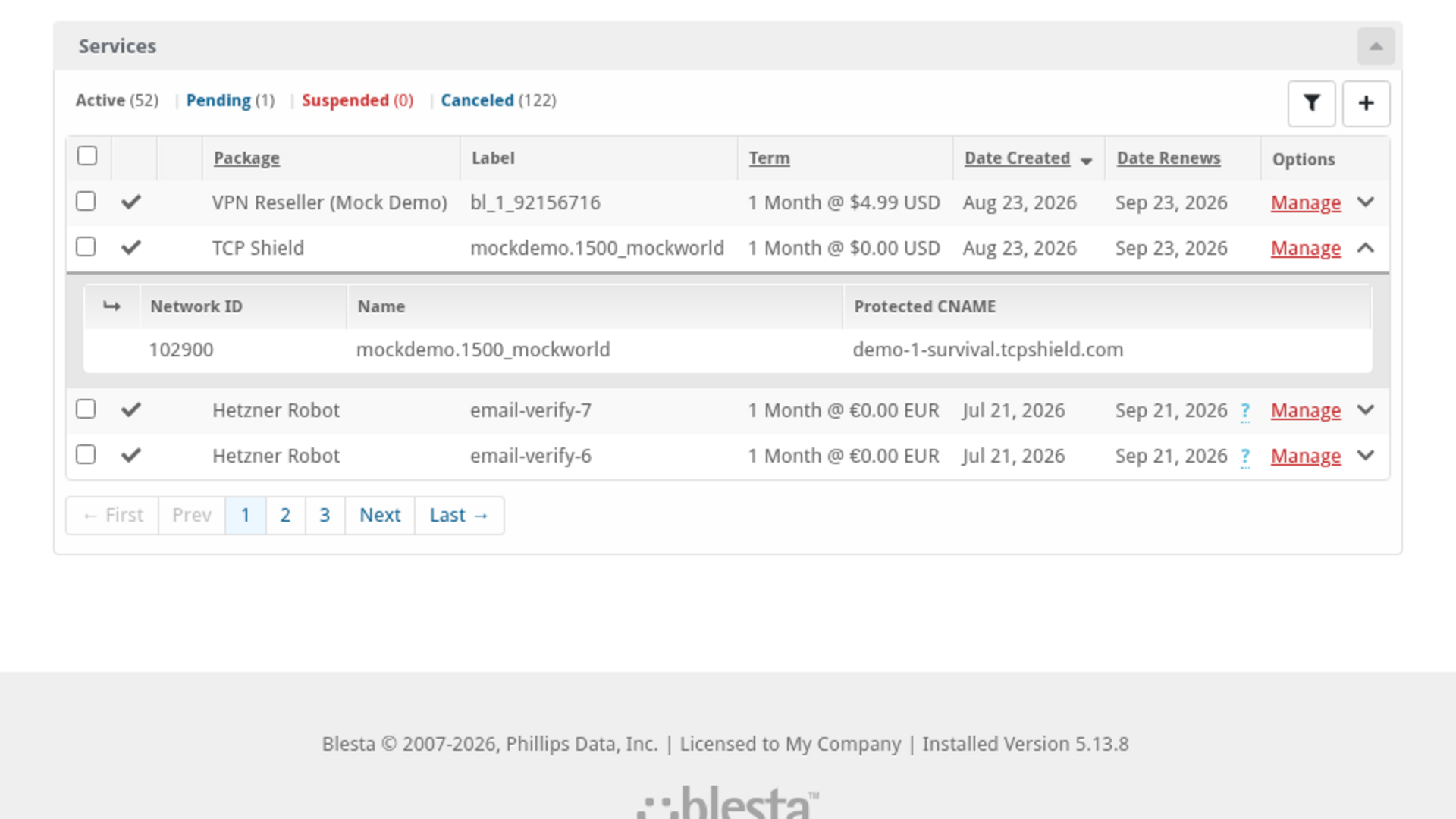
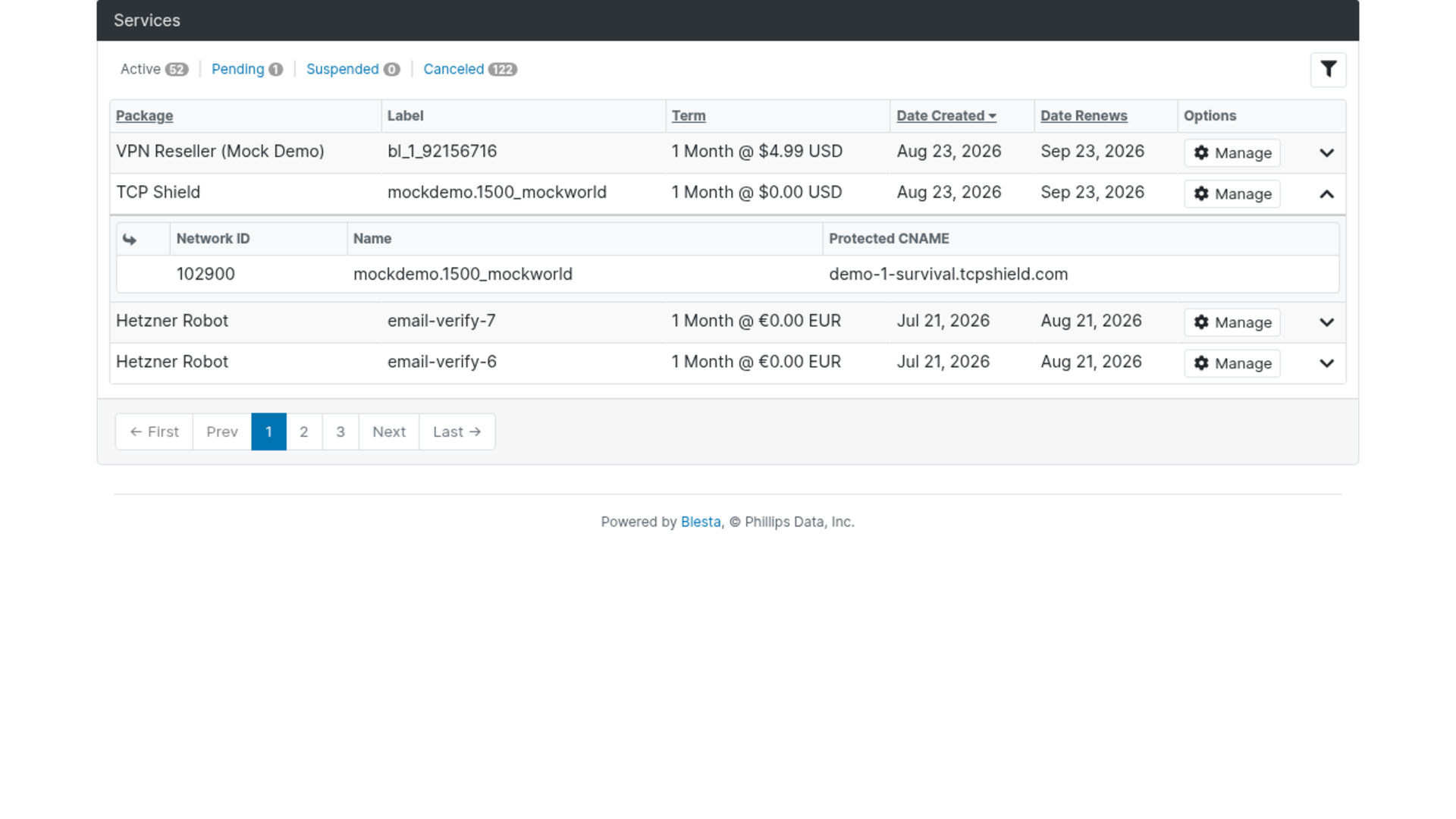
The moment a service goes active, Blesta creates the client's network at TCPShield and stores its Network ID, Name, and Protected CNAME on the service - these three fields appear on the service summary, and the Protected CNAME is also available as a welcome email tag. Renaming the service in Blesta renames the TCPShield network to match.
Managing a client's network from the staff side
Open the service for full management and you'll find the same five tabs your clients get, mirrored for your team:
- Statistics - player count and bandwidth, charted over the last 24 hours, 2 days, or 7 days.
- Domains - the client's onboarding steps (protected CNAME, RealIP plugin download, DNS instructions) plus their Domain Management table: hostname, assigned backend set, Badlion support, and verification status. A Verify link next to an unverified domain opens the same guided TXT-record verification flow the client sees.
- Backends - the client's backend sets, each with its own list of
host:portbackends and a Proxy Protocol toggle. - Bedrock Backends - Bedrock tunnels, each with a name, assigned backend set, location, and Proxy Protocol toggle.
- Firewall - CIDR firewall rules with a Whitelist toggle.
Use these to add, edit, or remove anything on the client's behalf without needing their login.
Suspending and canceling
Suspending a service doesn't delete the client's configuration - it snapshots every backend set and repoints them so nothing resolves, then restores the exact same backends when you unsuspend. Canceling does not remove the network at TCPShield; it only affects the Blesta service.
For your clients
Domains tab
The first tab a client meets after ordering. It walks them through three onboarding steps - their protected anycast CNAME, downloading the RealIP plugin for Bungee, Spigot, or Velocity, and the exact DNS records to create - then lists their domains below with the same add, edit, remove, and Verify controls staff have. Verifying asks them to add a TXT record and click Verify once it has propagated.
Backends, Bedrock Backends, and Firewall tabs
Clients manage their own backend sets (name, backend list, Proxy Protocol), Bedrock tunnels (name, backend set, location, Proxy Protocol), and CIDR firewall rules (with a Whitelist toggle) - the same controls your staff have, scoped to their own network.
Statistics tab
Charted player count and bandwidth for their network, with a period selector for the last 24 hours, 2 days, or 7 days.
Good to know
- Mock API mode lets you try every screen above - ordering, all five tabs, suspension - without a TCPShield account at all. No network is ever created, changed, or deleted at TCPShield while an account has it ticked.
- Every request and response to TCPShield is recorded under Tools > Logs > Module Log - check there first when an action fails.
- Per-package domain and backend-set limits apply to your clients only; staff can always manage the client's network from the admin side regardless of the package's caps.
v3.0.0 - 2026-10-10
PHP 8.2 - 8.4 · Blesta 6.x
Blesta 6.0 or newer is now required; Blesta 5 installs should stay on version 2.x.
Converted every staff screen - the account list, the Add Account and Edit Account forms, the service information panel, the five staff service tabs (Statistics, Domains, Backends, Bedrock Backends, Firewall) and the staff domain verification dialog - to the Blesta 6 admin theme, including dark mode. The Edit and Delete links on the account list are now buttons and both account forms gained a Back button. The staff Statistics charts are drawn with the admin theme's own chart library and recolour when the theme is switched. In the four staff management tabs every row now submits on its own and a delete asks for confirmation in the Blesta 6 dialog. The client area is unchanged.
The account list no longer shows the first characters of a stored API key; it shows a fixed mask instead. In the staff Backends tab the backend list is a multi-line field that wraps instead of scrolling inside the box, and backends may be separated by commas or by new lines.
v2.0.0 - 2026-09-11
PHP 7.2 - 7.4, 8.1 - 8.4 · Blesta 5.x
Security: a domain, backend set, Bedrock tunnel or firewall rule id posted from a tab is now checked for shape and re-matched against the service's own network before any call is made, and every id is URL-encoded into the request path - a crafted id previously steered the call at a different network on the same TCPShield account, with the account API key attached, and only the module log showed it. The Network ID is an admin-only field and is now dropped from any client-driven order or service edit and rejected when another active service already holds it - a client could otherwise bind their service to another customer's network and then rename, manage or delete it.
Fixes: a failed backend-set update during suspend or unsuspend is now reported instead of silently ignored (a service could read Suspended while it kept proxying traffic, or stay dead after payment); the pre-suspension snapshot is written before anything is changed, is no longer overwritten by a second suspension - which used to replace the stored backends with 0.0.0.0:0 permanently - and is cleared once restored. Every delete in the Domains, Backends, Bedrock Backends and Firewall tabs now asks for confirmation, and the record to delete travels in its own field so a delete cannot act on the wrong row. API calls carry a total timeout, not only a connect timeout, so a stalled response no longer holds a page or a cron run until PHP's execution limit, and the TLS floor is TLS 1.2. An API response whose body spans more than one line is no longer truncated to its last line (it decoded as nothing while the request still read as successful). A backend list typed without spaces after the commas is split correctly instead of being sent as one malformed backend, and the expected format is spelled out in the tab. The statistics charts cast their plotted values numerically. The five staff-side service tabs (Statistics, Domains, Backends, Bedrock Backends, Firewall) now have their own admin-styled views instead of reusing the client portal's layout, so they match the rest of the admin panel instead of looking visibly out of place. The staff-side domain verification popup no longer renders as duplicated, unstyled chrome on top of the admin theme's own dialog; it now uses an admin-styled view like the rest of the staff tabs. The API Key and Mock API field help tooltips on the Add Account and Edit Account forms no longer drop onto their own line under the field; the Mock API checkbox tooltip in particular no longer floats disconnected from its checkbox.
Features: staff can now manage a client's domains, backends, Bedrock tunnels and firewall from the admin service page; the protected CNAME is stored as a service field, shown on the service summary and available to the welcome email as a tag; renaming a service now renames its TCPShield network; the Statistics tab has a period selector (last 24 hours / 2 days / 7 days); packages can cap the number of domains and backend sets a client may add.
Action required after upgrading from v1.0.0: re-save each TCPShield account. v1.0.0 stored the account API key in plain text, offered it as an email tag and used it as the account's display key; all three are fixed, but an existing account keeps its plaintext key until it is saved again.
v1.0.0 - 2024-09-22
PHP 7.2 - 7.3, 8.1 - 8.4 · Blesta 5.x
Blesta Club release
Pricing Options
Get exactly what you need and want.
Requires PHP 8.2 - 8.4 · Blesta 6.x
Included In
Value: £42.3
- +51 Other Extensions
- Additional Discounts
- Included Support & Updates
Leased
- Partially Encoded
- Full Functionality
- Included Support & Updates
Owned
- Partially Encoded
- Buy Once Use Forever
- 1 Year Support & Updates
Owned - Source
- Source Available
- Buy Once Use Forever
- 1 Year Support & Updates
Not sure whether to lease or own? Our FAQ explains how the licence types differ.
Reviews
What our customers say
(0 customer reviews)
Seems like this extension doesn't have reviews yet...
Be one of the firsts to leave a review!
It is possible to leave a review only if you have purchased this extension or a Club tier which contains it.
We reserve the right to alter wording or formatting for presentation.
We will discuss any changes made and offer the option to withdraw review text if the changes can't be agreed on.
It may take up to 1 hour for a review to appear or update due to caching.
You might also like
More extensions to explore

Module
BunnyDNS
Integrate BunnyDNS for automatic DNS provisioning and management.
PHP 8.2 - 8.4 · Blesta 6.x

Module
Cloudmini
Integrate Cloudmini for automatic cloud hosting provisioning.
PHP 7.2 - 7.4, 8.1 - 8.4 · Blesta 5.x

Module
Convoy Panel
Provision servers using Convoy, a Proxmox based VPS management panel
PHP 8.2 - 8.4 · Blesta 6.x

Module
Datalix
Integrate Datalix module into your Blesta install to provision VPS servers.
PHP 8.2 - 8.4 · Blesta 6.x

Module
Enhance
Integrate Enhance for automatic provisioning and management.
PHP 8.2 - 8.4 · Blesta 6.x

Module
Hetzner Cloud
Integrate Hetzner Cloud for automatic server provisioning.
PHP 8.2 - 8.4 · Blesta 6.x