Proxmox Advanced
Give your clients a uniform and easy experience with their VPS on Proxmox like never before! With our Advanced Proxmox module they can handle nearly every single task from within the client area! This should drastically reduce support load and client satisfaction
From £124.99 - View Pricing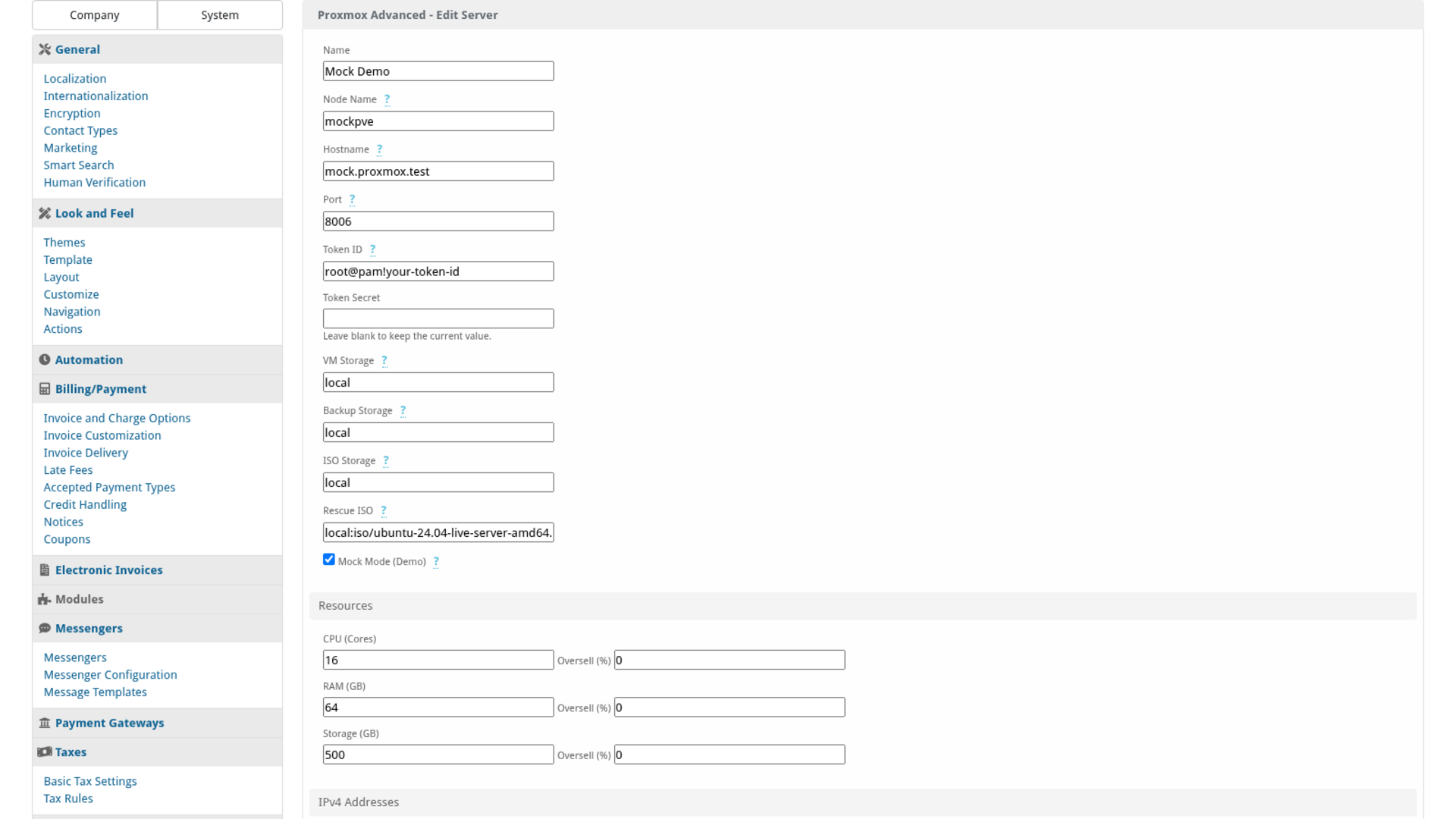
Features
What Proxmox Advanced gives you
Automatic Background Processing
Runs on Blesta's cron with no manual upkeep, so everything stays up to date on its own.
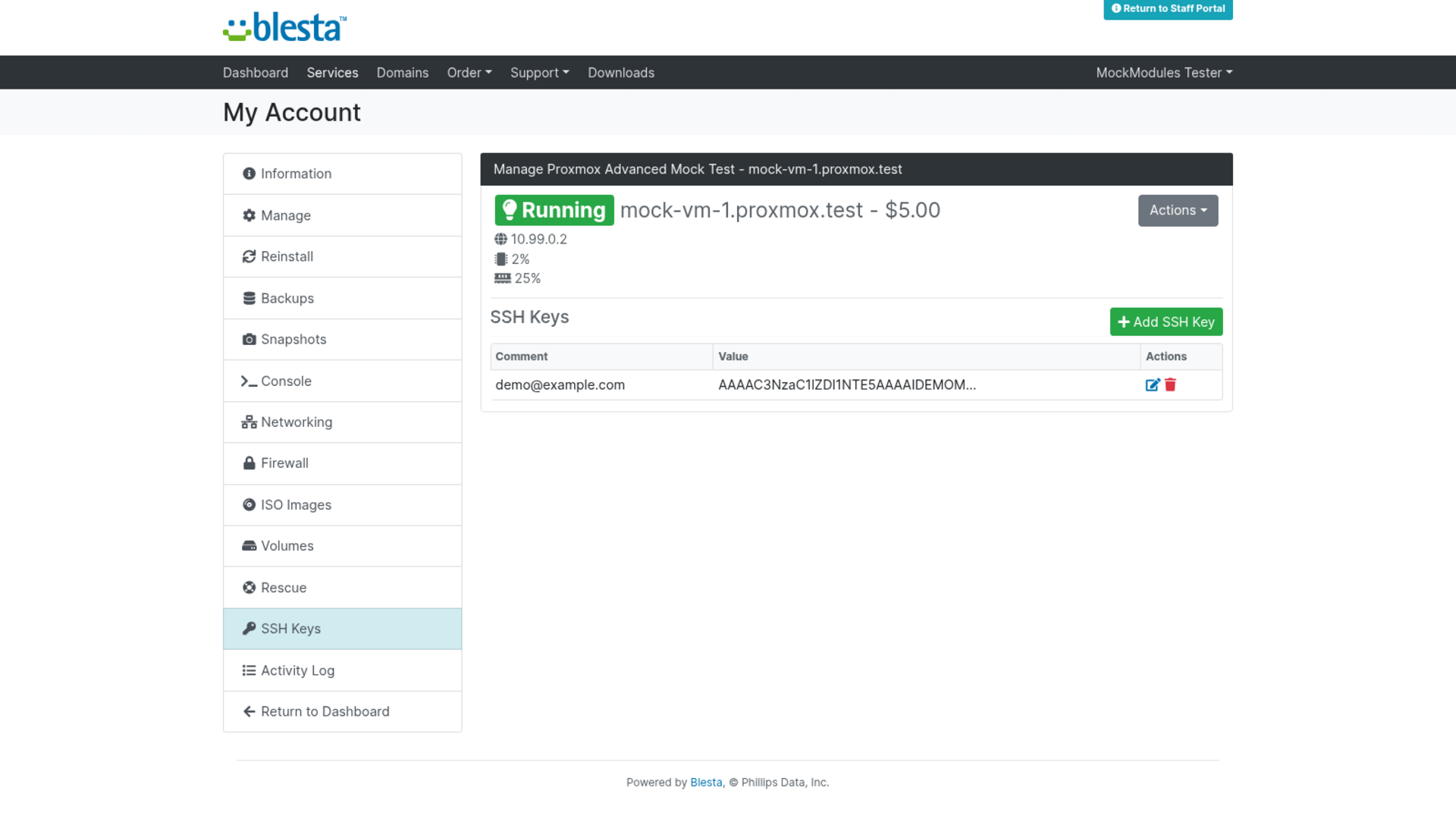
SSH Key Management
Clients manage the SSH keys on their machine from their own tab, with keys also accepted at order time.
Activity Log
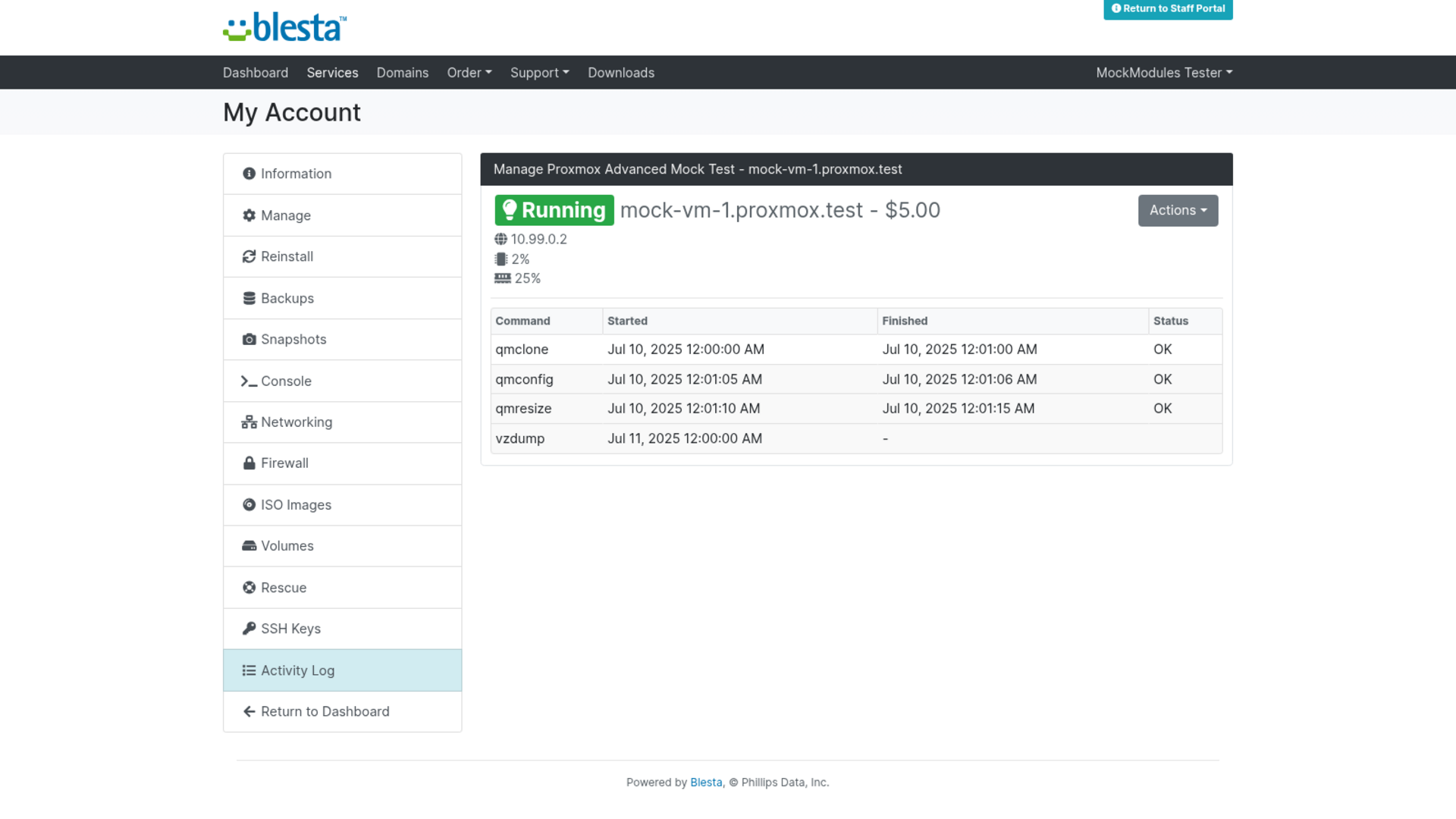
A paginated log of the tasks run against the machine, so clients and support can see what happened and when.
Per-Company Configuration
Configure it independently for each brand on a multi-company install, so every company runs with its own settings.
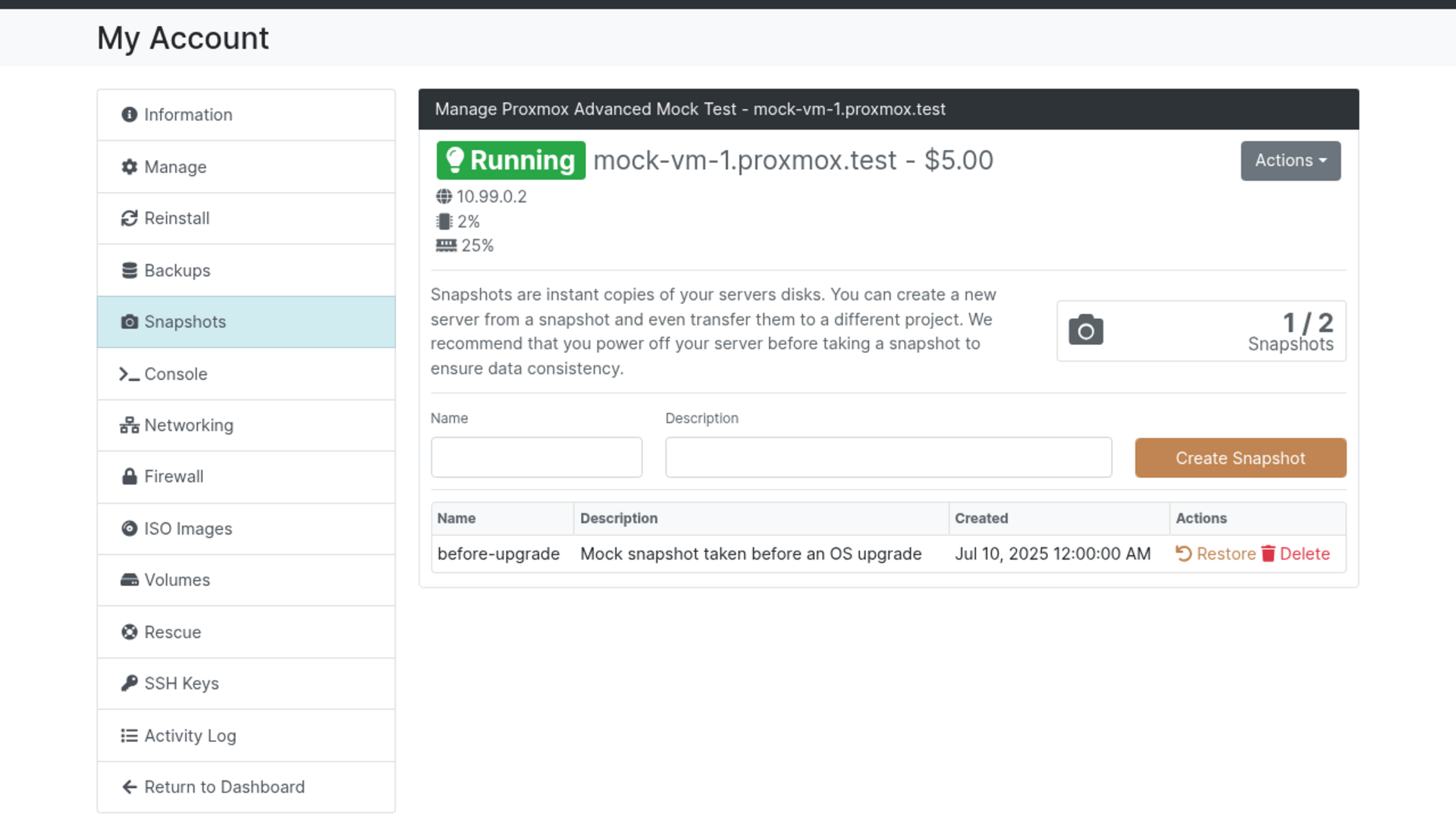
Snapshots
Instant named snapshots with descriptions, restored or deleted in one click and capped by the package's snapshot allowance.
Fully Translatable
Every staff and client label ships in editable language files, ready to translate into any language or reword to match your brand.
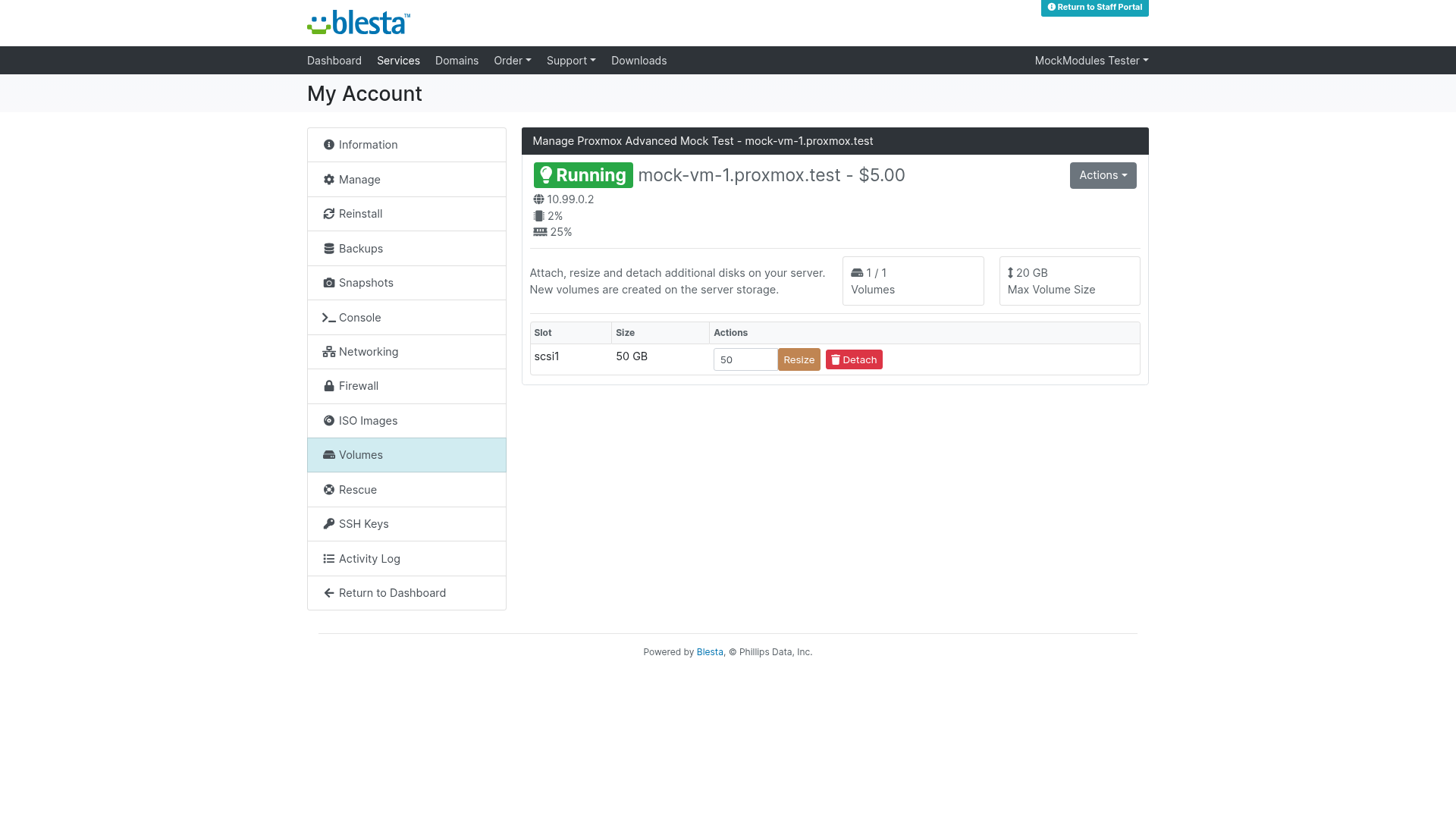
Additional Volumes
Clients attach and detach extra disks up to the number and maximum size their package allows, so storage can grow without a package change.
One-Click Reinstall
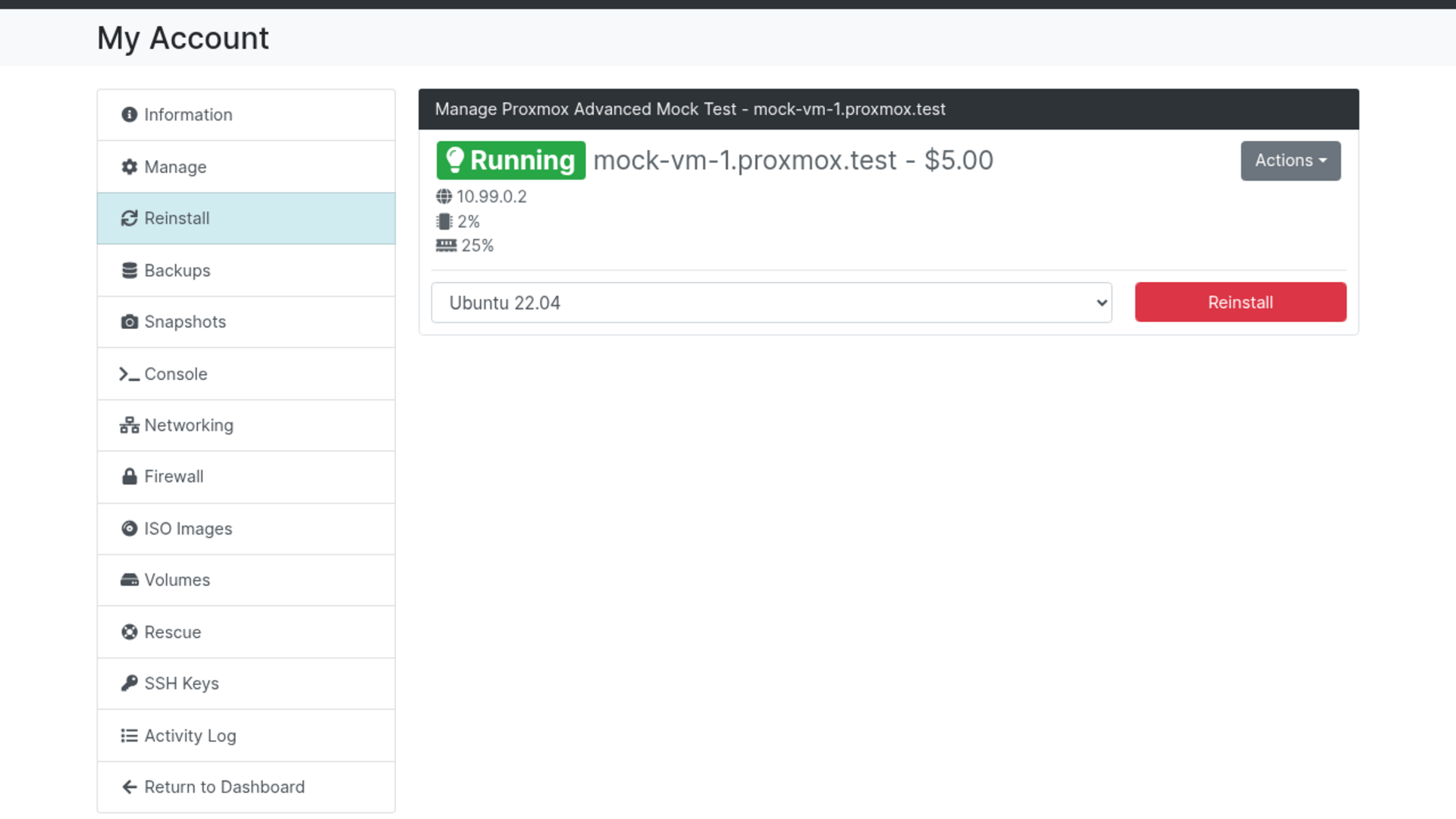
Clients rebuild their machine from any template you have published, each shown under a friendly display name you control rather than a raw template ID.
Built-In Demo Mode
A built-in demo mode runs the whole extension from bundled sample data, so you can trial every screen and action before you have an account or API key.
ISO Images
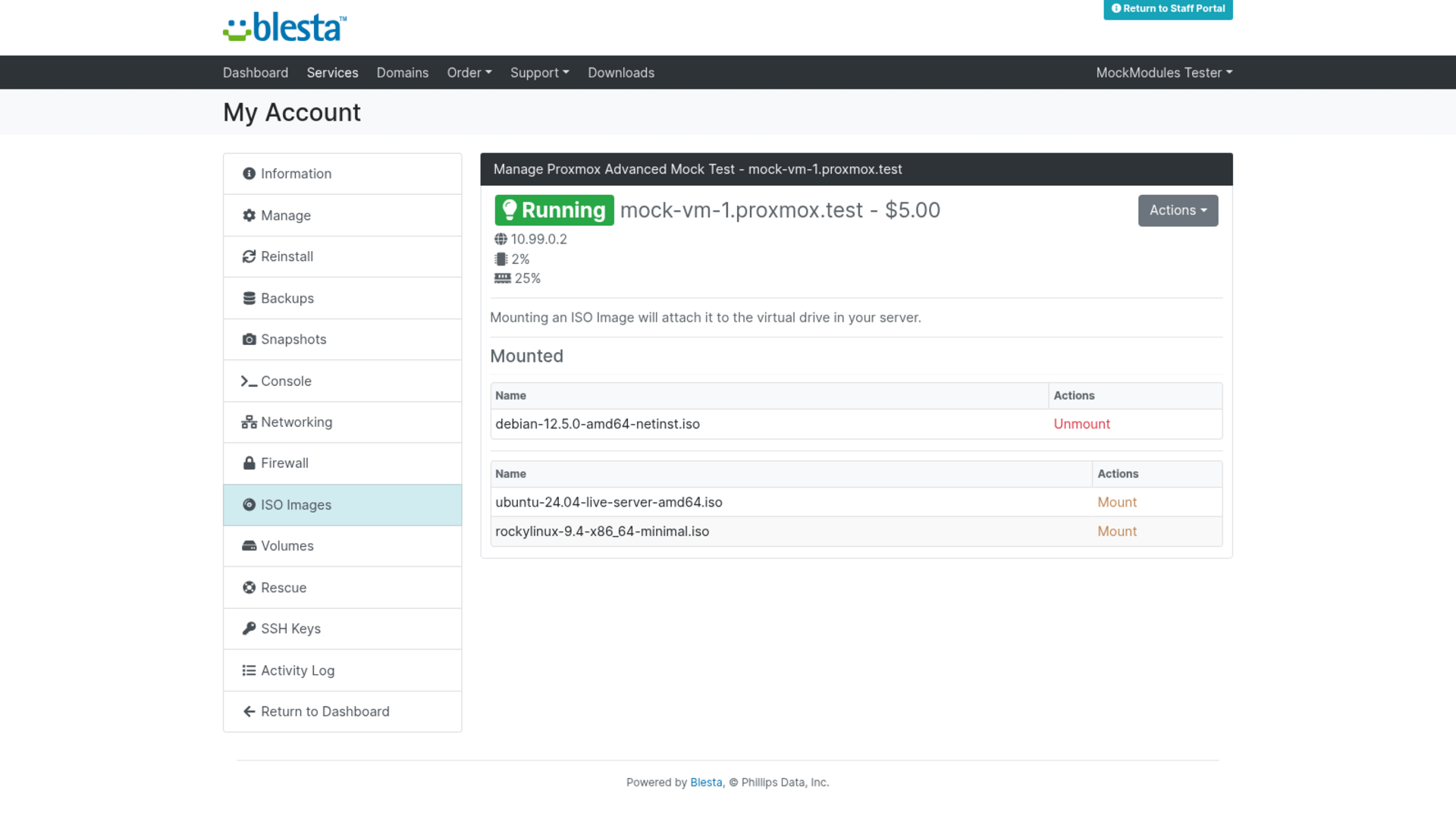
Clients mount and unmount ISO images from the images you publish on the server's ISO storage, and boot from them, for their own installs and recovery work.
API Token Authentication
Connects with a Proxmox API token rather than a stored root password, and verifies the node, token, and each storage location before a server can be saved.
Firewall Management
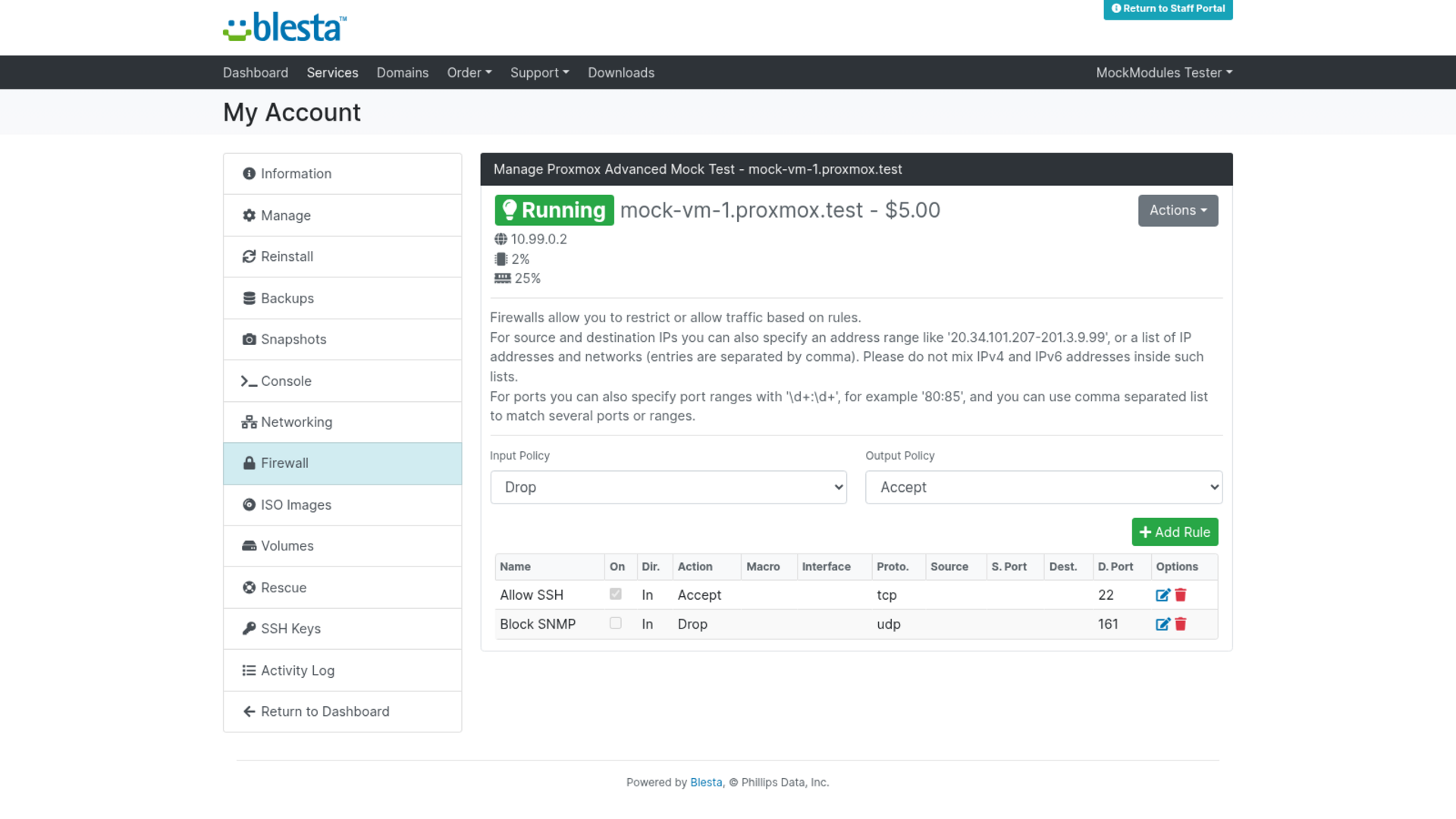
Clients build firewall rules with direction, action, protocol, ports, and ICMP types from readable named lists, so protection does not need a Proxmox login.
Bandwidth Warning Emails
Clients are emailed once they pass a percentage of their allowance that you choose, so an overage is never a surprise. Set the threshold to 0 to turn warnings off.
Rescue Mode
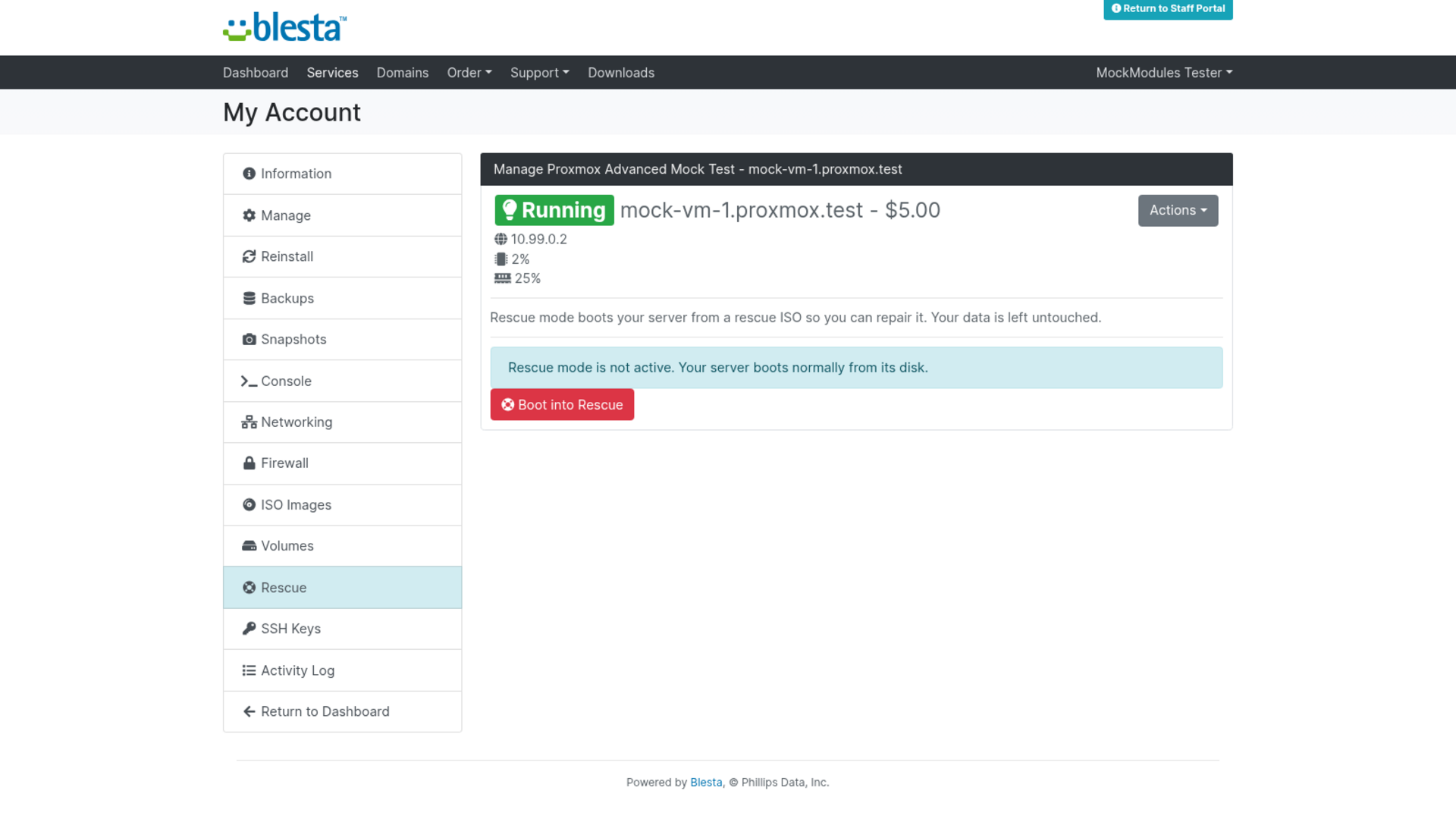
Point a server at a rescue ISO and clients get a Rescue tab that boots the machine into it and back out again - and the tab stays hidden on servers where you have not set one.
Browser Console
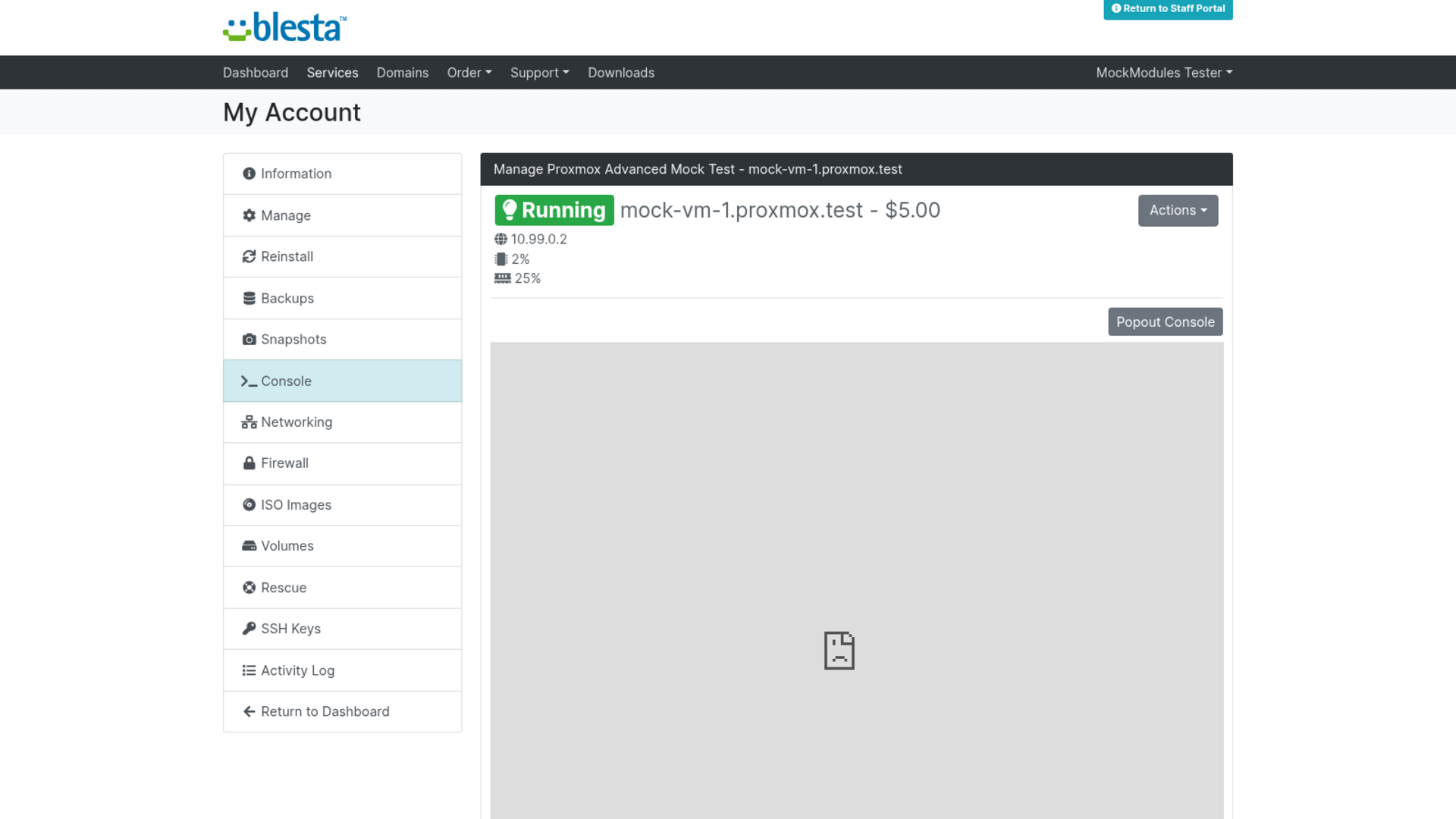
Clients open a noVNC console straight from the service page, with a pop-out window for full-screen work. Console access is enabled per server and handled entirely by the module.
Client Power Controls and Live Statistics
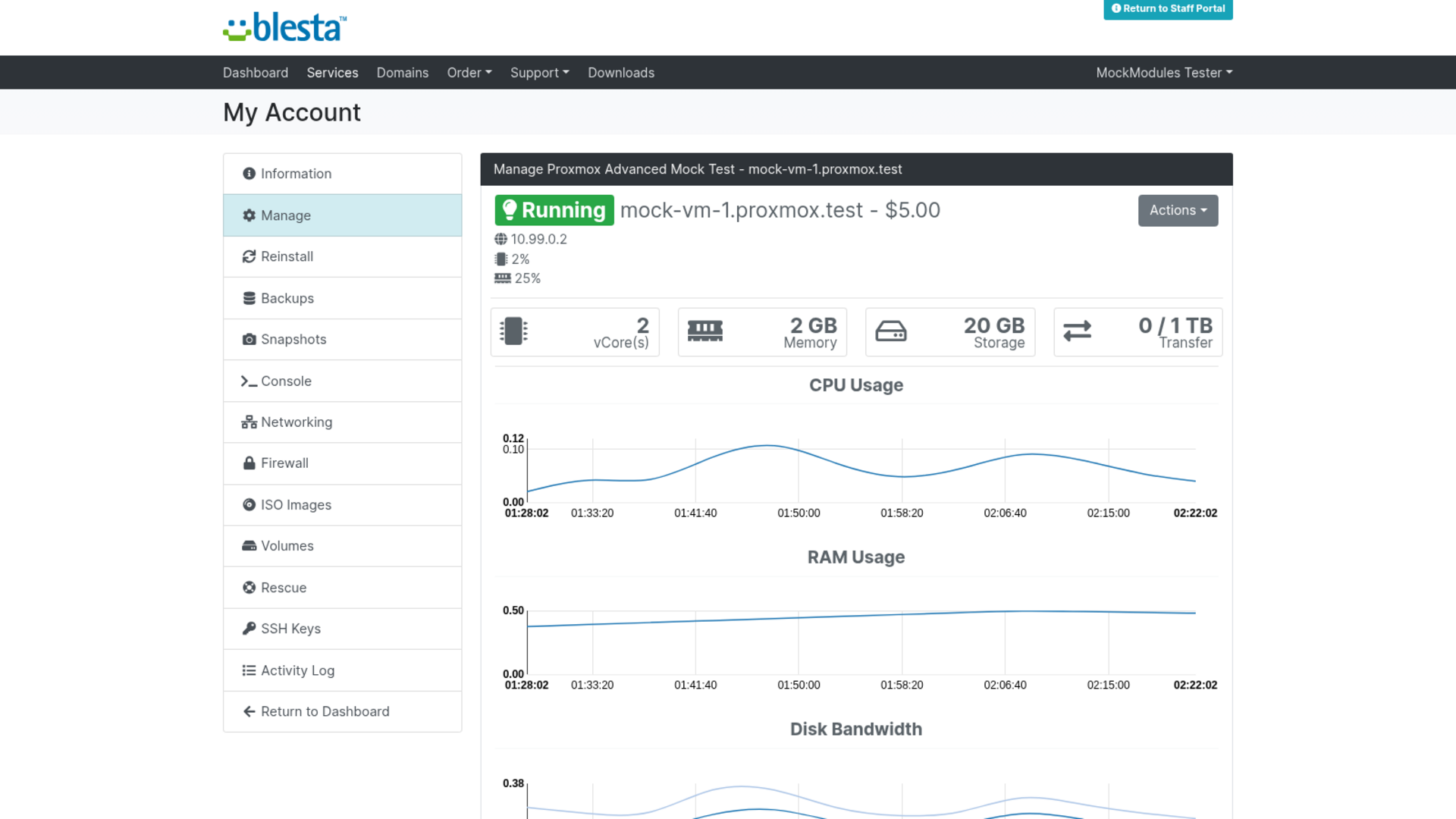
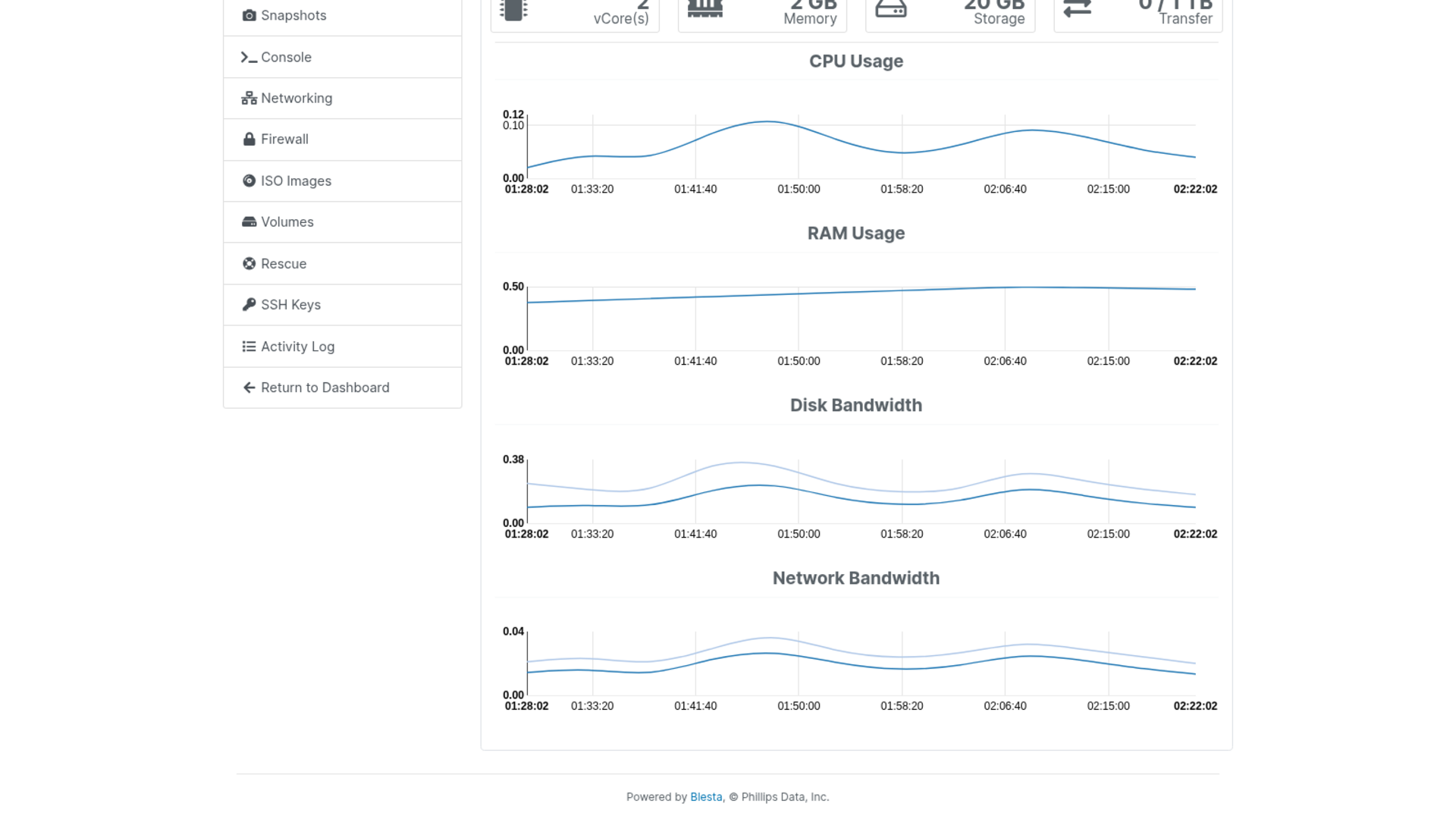
Every tab carries a status header with soft and hard power actions and live vCore, memory, storage, and transfer figures, so clients can see and steer their machine without a ticket.
Full Resource Plans per Package
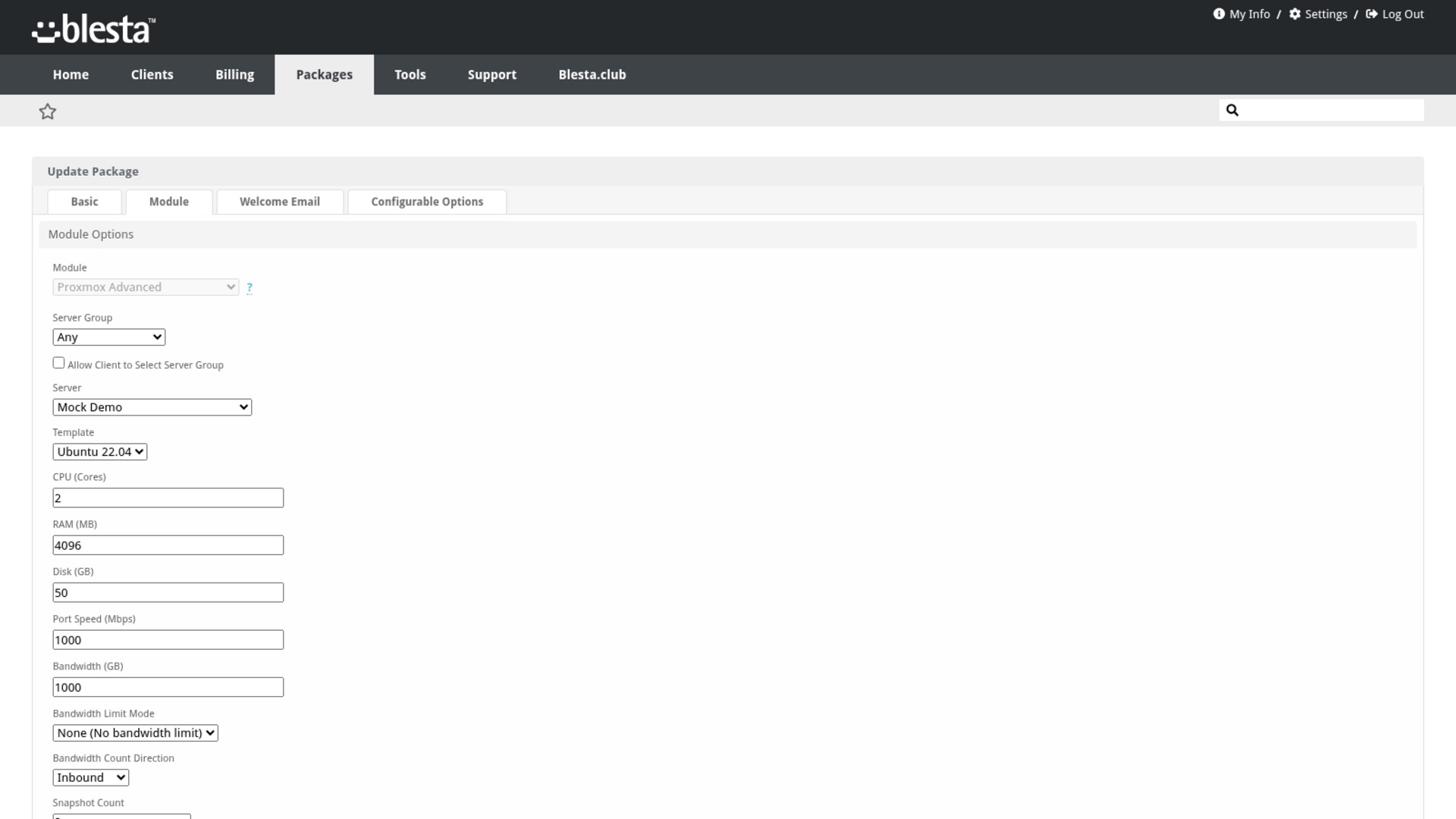
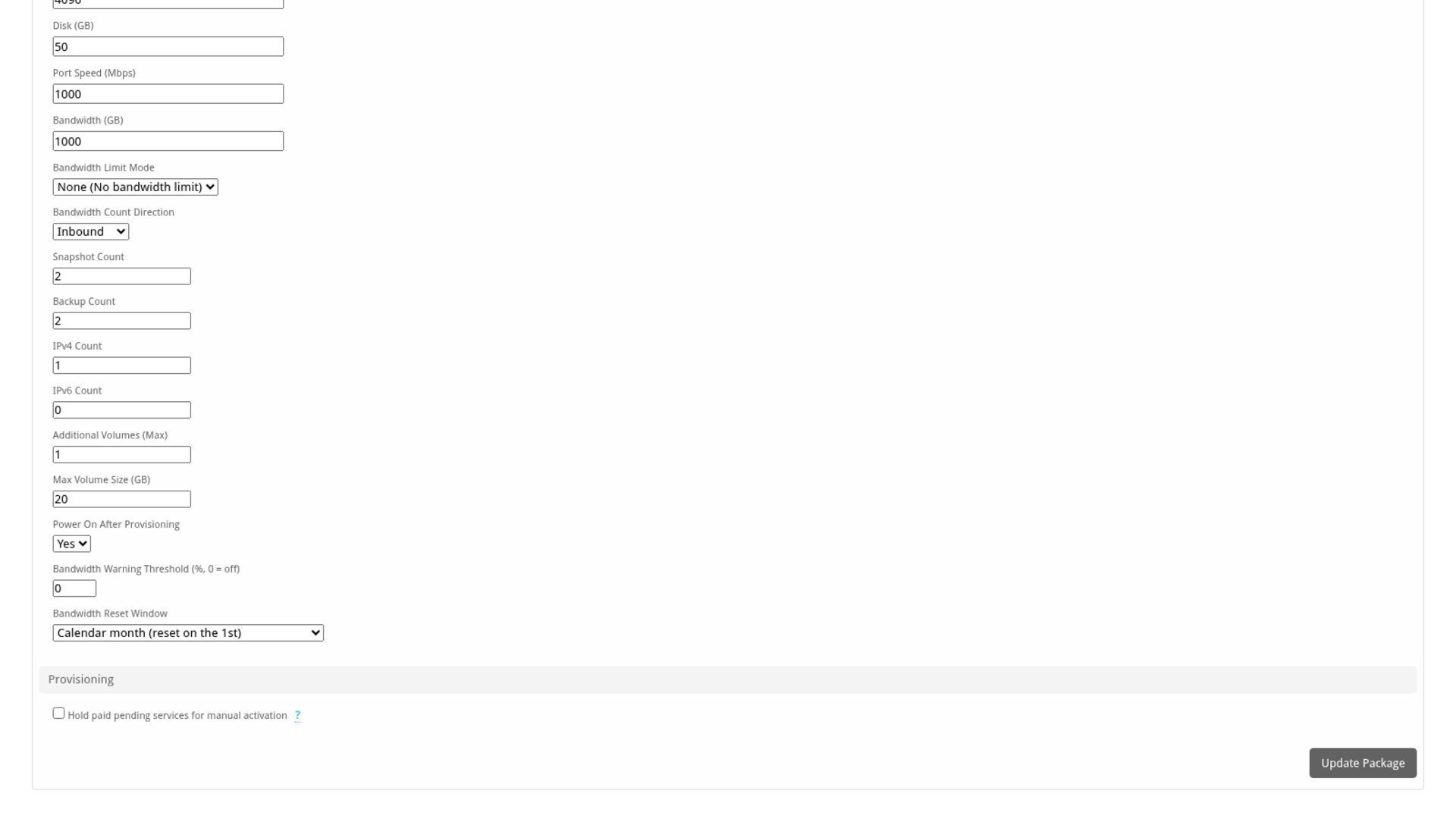
Set CPU cores, RAM, disk, port speed, bandwidth allowance, IPv4 and IPv6 counts, snapshot and backup allowances, and how many extra volumes a plan may attach and how large each may be.
Sell Every Size from One Package
Attach configurable options named for any package resource - CPU, RAM, disk, bandwidth, IP counts, backup and snapshot slots - and clients build their own machine at checkout, with the changes applied to the running VM.
Networking and IP Pools
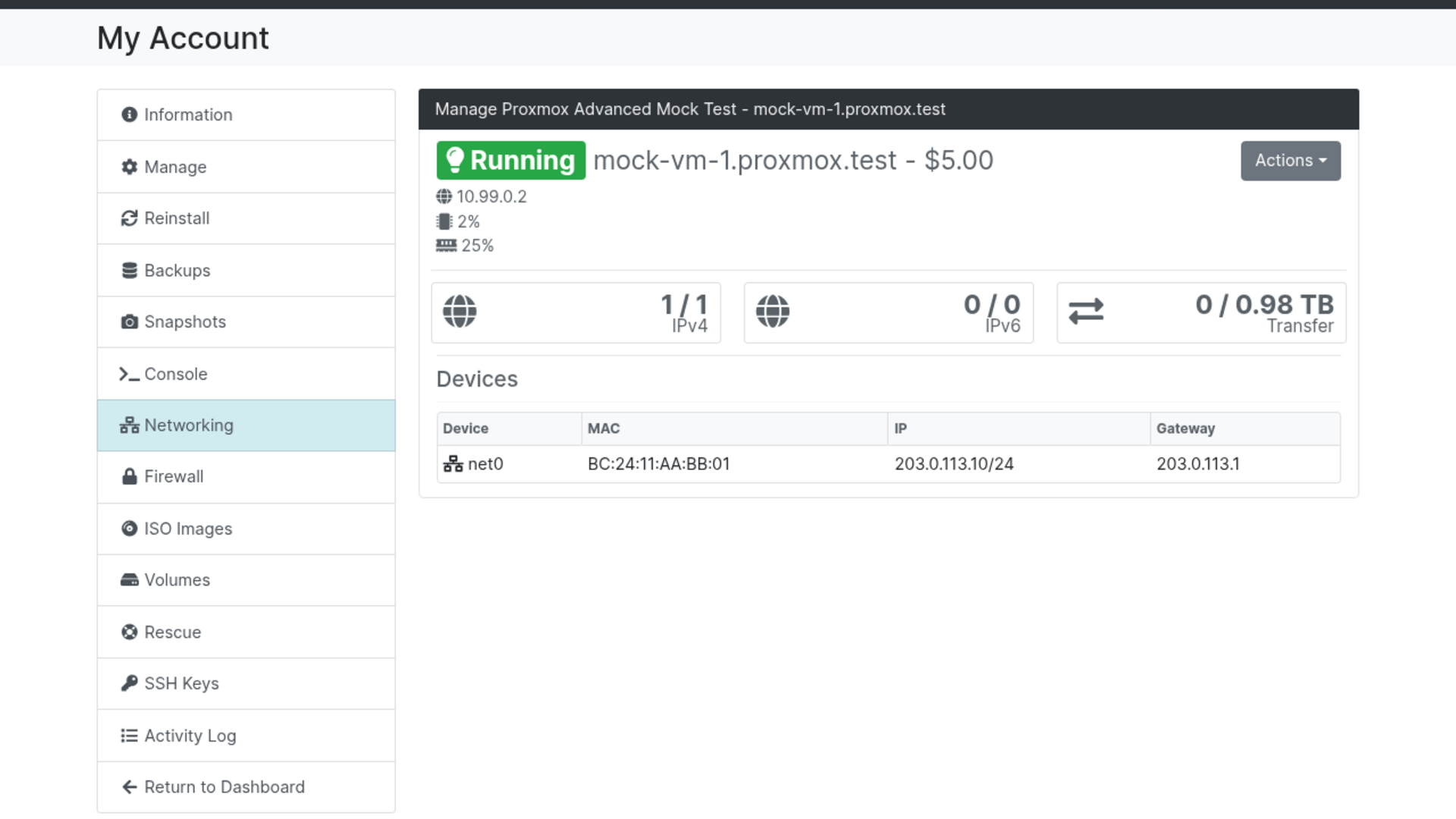
Hold the IPv4 and IPv6 pool on each server with device, CIDR, gateway, and MAC, and the module assigns and releases addresses per machine automatically. Clients see their devices and transfer figures on a Networking tab.
Instant VM Provisioning from Templates
A paid order clones the package's template into a ready-to-use VM with its hostname, login user, password, SSH keys, and networking configured, and boots it automatically unless you choose to leave new machines powered off.
Backups and Automatic Backup Schedules
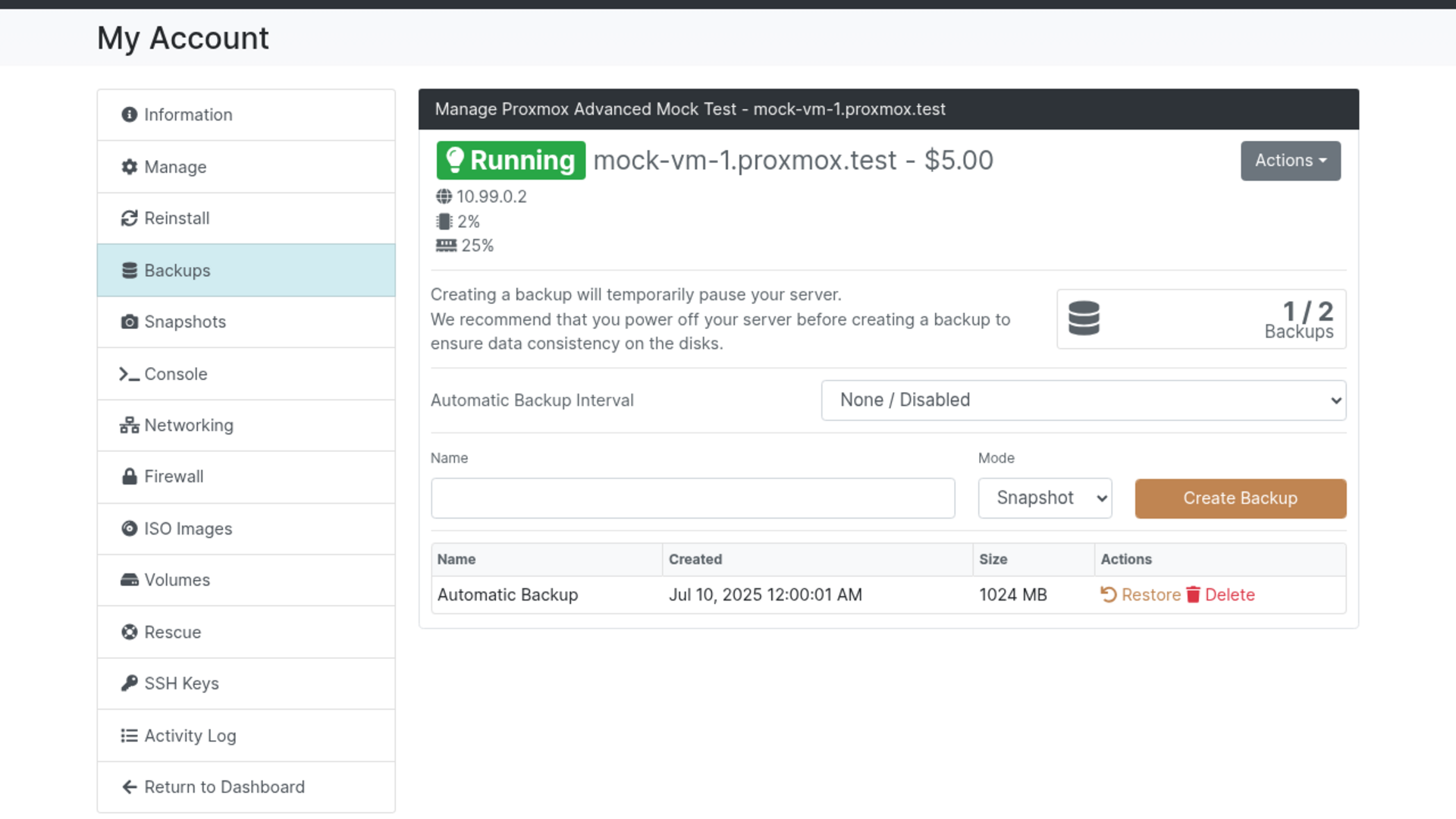
Clients create, restore, and delete backups within the slots their package allows, choosing the backup mode, and can switch on daily, weekly, or monthly automatic backups with the oldest rolled off once the limit is reached.
Multi-Node with Oversell and Allocation Strategies
Register as many Proxmox nodes as you need with their own CPU, RAM, and storage capacity plus an oversell percentage, then place new orders on the node with the least allocated resources, the least allocated IPs, or simply the first node with room.
Bandwidth Metering with Suspend or Throttle
Usage is measured hourly and counted inbound, outbound, or both. Exceed the allowance and the module either suspends the machine or throttles it to a speed you set, then restores it automatically when the allowance resets - on the calendar month or on the service's own renewal day.

Proxmox Advanced
Sell Proxmox VE virtual machines with a complete client control panel - power, console, reinstalls, backups, snapshots, firewall, ISOs, volumes, and rescue mode.
What it does
Selling virtual machines usually means either building your own control panel or leaving clients locked out of basic tasks like a reboot or a firewall rule. Proxmox Advanced turns your Proxmox VE cluster into a full VPS hosting product inside Blesta: a paid order provisions a real virtual machine automatically, and every client gets a complete self-service panel to manage it from day one, no ticket required.
Key features
- Instant VM provisioning: A paid order clones your chosen template into a ready-to-use virtual machine, complete with hostname, login, SSH keys, and networking, and boots it automatically.
- A complete self-service control panel: Clients manage power, console access, reinstalls, backups, snapshots, firewall rules, ISO mounts, extra volumes, and rescue mode, all without opening a support ticket.
- Flexible resource plans: Set CPU, RAM, disk, bandwidth, IP counts, and volume limits per package, or let clients build their own machine at checkout with configurable options.
- Bandwidth control that protects your network: Usage is measured automatically, and once a plan's allowance is used up the machine is suspended or throttled to a speed you choose, then restored automatically when the allowance resets.
- Bandwidth warning emails: Clients are emailed before they run out, so an overage is never a surprise.
- Scale across multiple Proxmox nodes: Register as many nodes as you like with their own capacity and an oversell percentage, and let new orders land automatically on the node with the most room.
- Try it before you connect a server: A built-in demo mode runs every screen and action from bundled sample data, so you can see exactly how it works before entering real credentials.
Installing and updating extensions can now be done automatically through the Blesta Club Subscription Manager - this is the recommended way going forward.
Installing Proxmox Advanced
Before you start
- Version 3.x requires Blesta 6.0 or later. On a Blesta 5 install, use version 2.x instead.
- If you are on the leased (subscription) licence, the Blesta Club Subscription Manager must be installed and your subscription active. The owned and owned-source licences have no such requirement.
1. Upload the files
Upload the extension folder into your Blesta installation so it lands under your Blesta directory at:
components/modules/proxmox_advanced/For example, on a typical install: /var/www/html/blesta/components/modules/proxmox_advanced/
2. Install it in Blesta
- Log in to your Blesta admin area with a staff account that has the Modules permission (with Install Module / Manage Module) under the Settings group in Manage Staff Groups.
- Go to Settings > Company > Modules and click the Available tab.
- Find Proxmox Advanced in the list and click Install.
3. Configure it
- Go to the Installed tab and click Manage next to Proxmox Advanced.
-
Click Add Server to connect your first Proxmox node. You'll need:
- A name for the server, its node name, hostname/IP, and API port.
- A Proxmox API token (Token ID and Secret), created in Proxmox under Datacenter > Permissions > API Tokens.
- The storage names on that node to use for VM disks, backups, and ISOs.
- The node's CPU, RAM, and storage capacity, each with an optional oversell percentage.
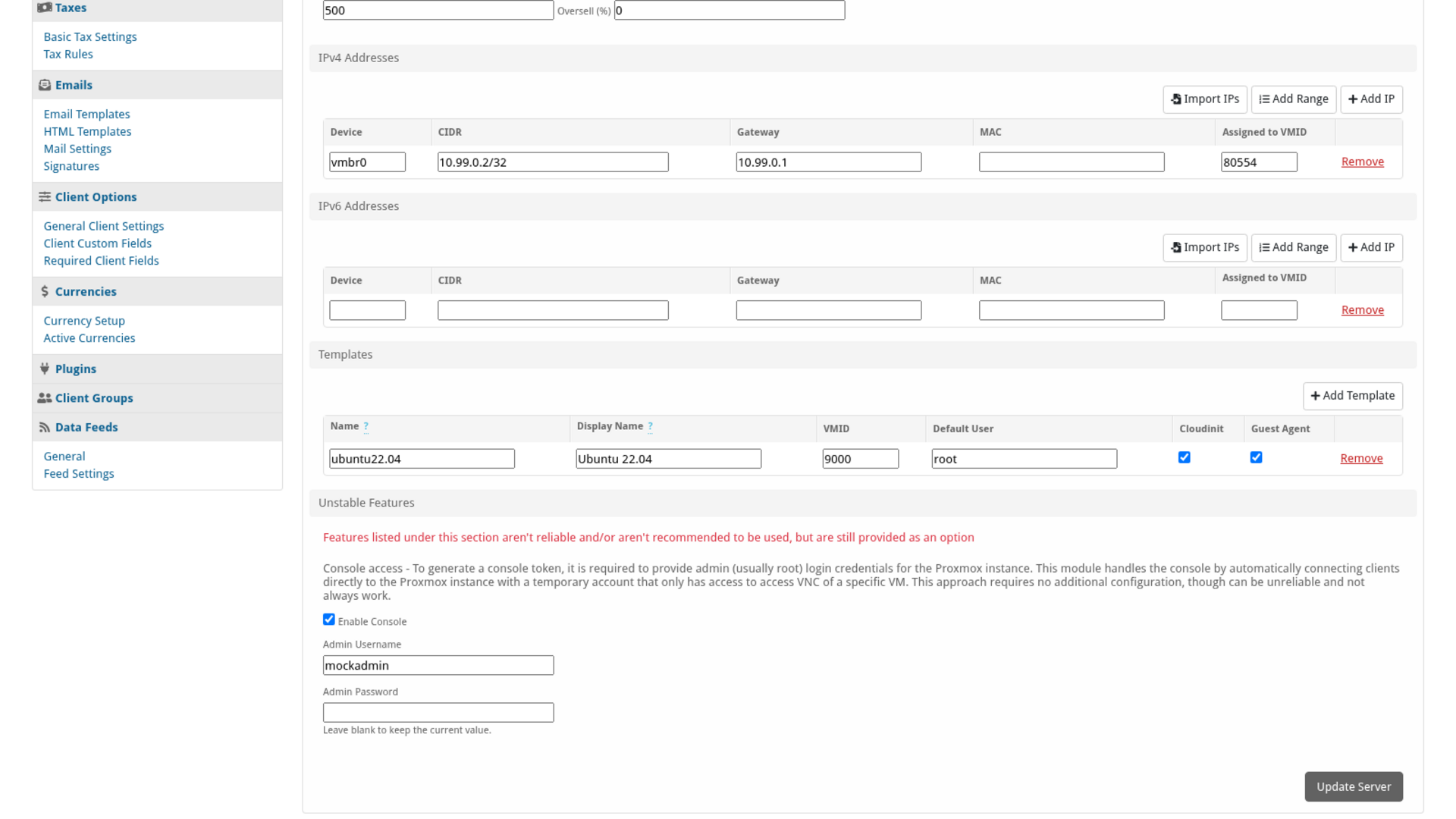
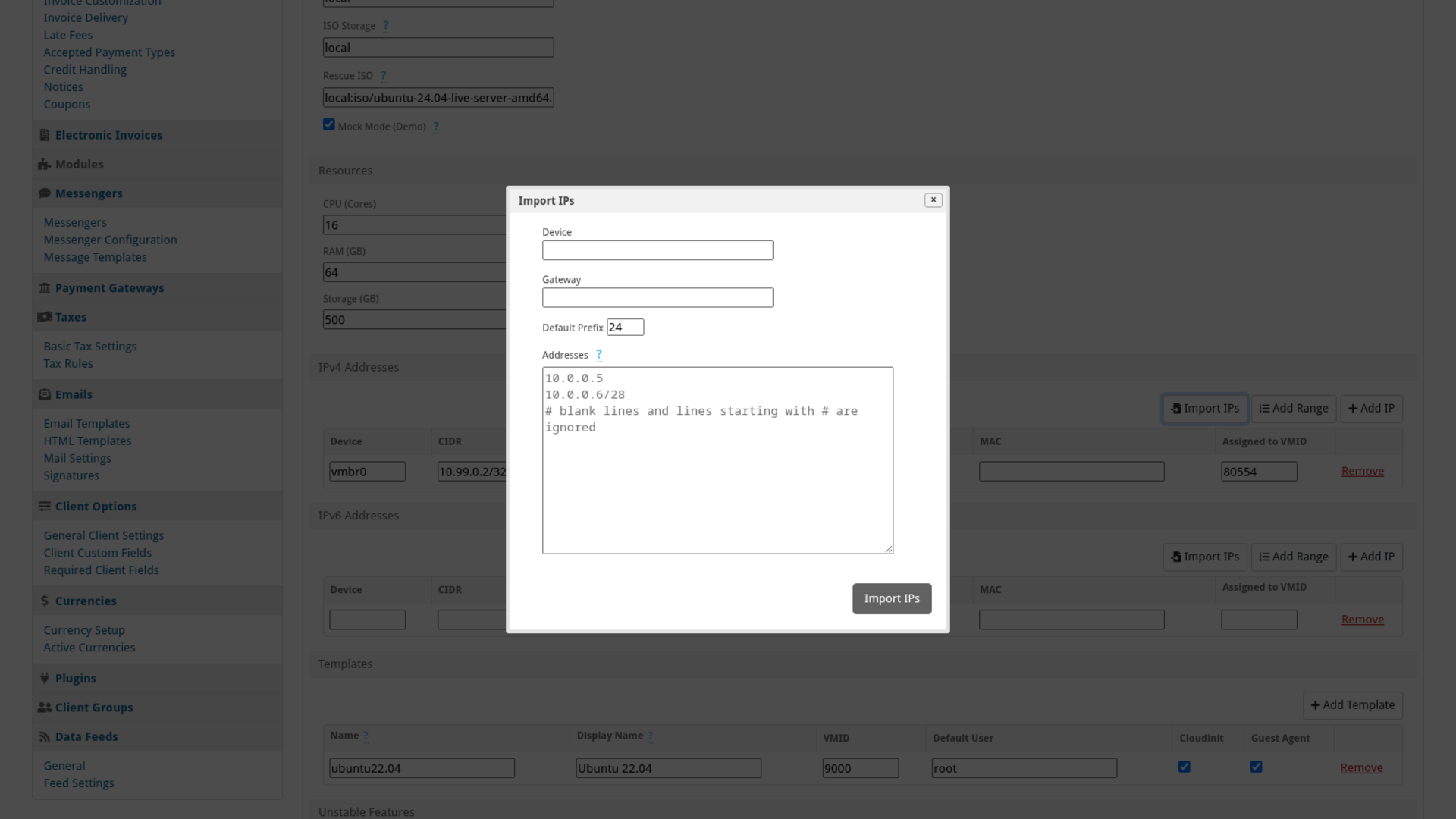
- The IPv4 and IPv6 addresses available on the node, so the module can assign them to new servers.
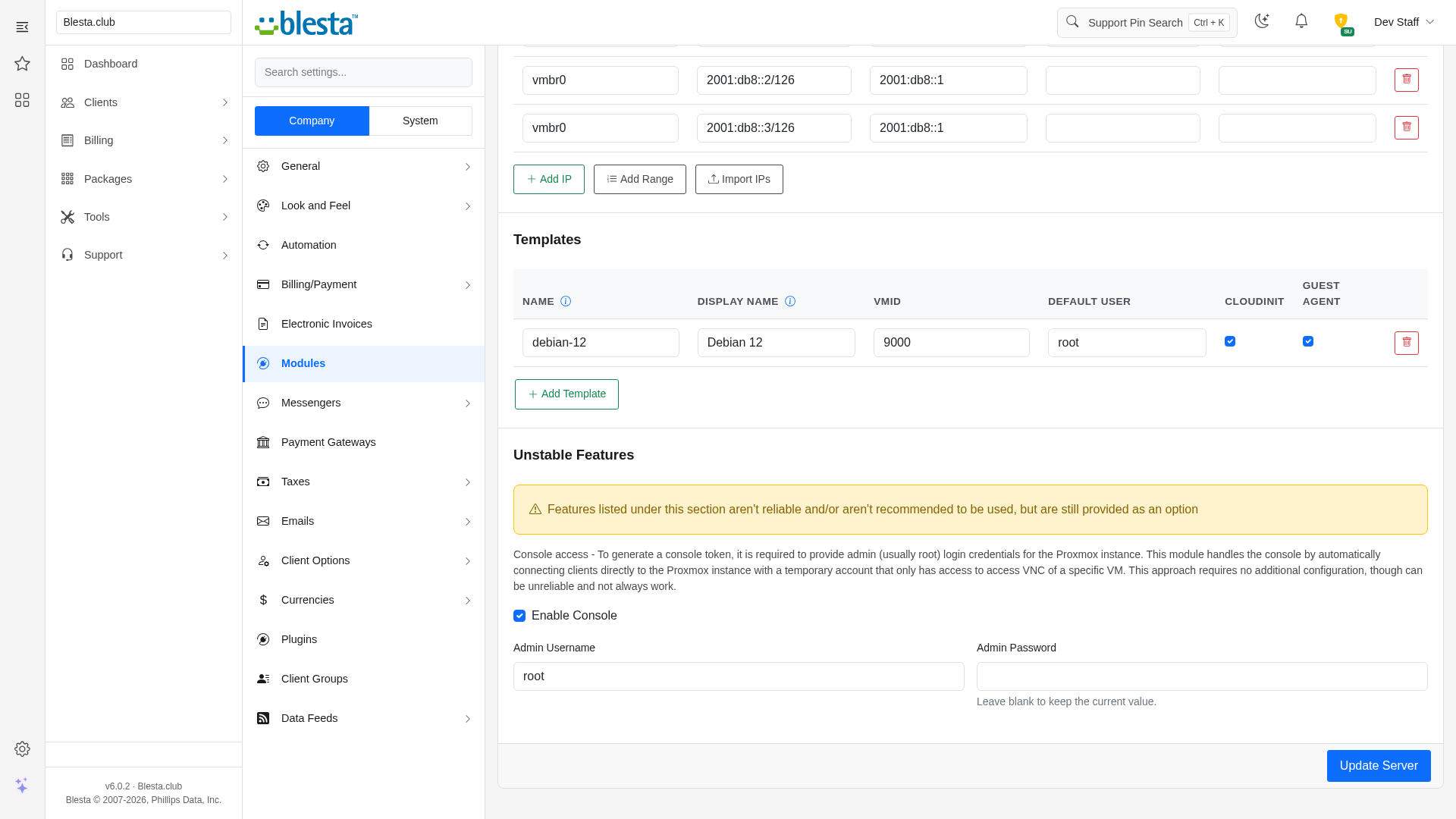
- The templates clients can provision from, and (if you want console access) an admin username and password used to create per-session console logins.
Want to try it first? Tick Mock Mode (Demo) to add a server with no real node or credentials - every action is served from built-in sample data.
- Proxmox Advanced registers three background tasks (hourly bandwidth metering, scheduled bandwidth resets, and nightly automatic backups) that run automatically once installed, using Blesta's own cron - no separate setup is needed.
- Before clients can order, create a package, select Proxmox Advanced as its module, and set its resource limits and template on the module's own tab.
You're ready to go - see the usage guide for a walkthrough of day-to-day use.
Installing and updating extensions can now be done automatically through the Blesta Club Subscription Manager - this is the recommended way going forward.
Proxmox Advanced Module by Blesta.Club - Update Guide
To ensure you're always using the latest version of the Proxmox Advanced Module, follow these steps to update the module in your Blesta installation.
Steps for Updating the Module
1. Download the Latest Version
- Visit the download section of the client area to obtain the latest version of the Proxmox Advanced Module.
2. Upload the Updated Module
- Upload the updated files to your Blesta installation directory, replacing the existing files:
/var/www/html/blesta/components/modules/proxmox_advanced/
3. Update the Module in Blesta
- Log in to your Blesta admin account.
- Navigate to Settings > Company > Modules.
- Locate the Proxmox Advanced module in the list and click Update to run the upgrade.
Notes for v3.0.0
- Requires Blesta 6.0 or later - upgrade Blesta first, then the module. Blesta 5 installs should stay on 2.x. Nothing changes in your servers, packages or services; the staff screens take on the Blesta 6 admin theme, the Edit and Delete links on the server and group lists become buttons, and the Add Range / Import IPs tools open as Blesta 6 dialogs.
Notes for v2.0.0
- Servers now power on after provisioning. The new "Power on after provisioning" package option defaults to on, so newly provisioned and reinstalled VMs boot automatically where they previously stayed off. Turn it off per package if you provision servers that must stay powered down.
- The upgrade removes surplus cron task run rows left behind by earlier versions. If the bandwidth cron had been counting traffic several times over, that stops after the upgrade.
- A new client email, Proxmox Advanced Bandwidth Warning, is registered per company on upgrade. It is sent once per billing cycle when a service crosses the package's bandwidth warning threshold (leave the threshold at 0 to disable it). If it is not offered for editing under Settings > Company > Emails, change its default wording in
config/proxmox_advanced.phpbefore upgrading. {package.storage}never resolved and has been replaced by{package.disk}for the disk size; update any email template that used it.
Notes for v1.4.0
- The
token_idandsecretmodule email tags were removed for security; update any email templates that referenced them. - A Mock Mode (Demo) option is now available on the server form for credential-free demos and testing.
Troubleshooting Update Issues
File Errors:
- Ensure that all files have been uploaded and named correctly and that permissions are properly set.
Contact Us
If you encounter any issues during the update process or have suggestions for improving the module, please reach out to us. We are dedicated to providing ongoing updates and value customer feedback.
Using Proxmox Advanced
For your staff
Adding and managing Proxmox servers
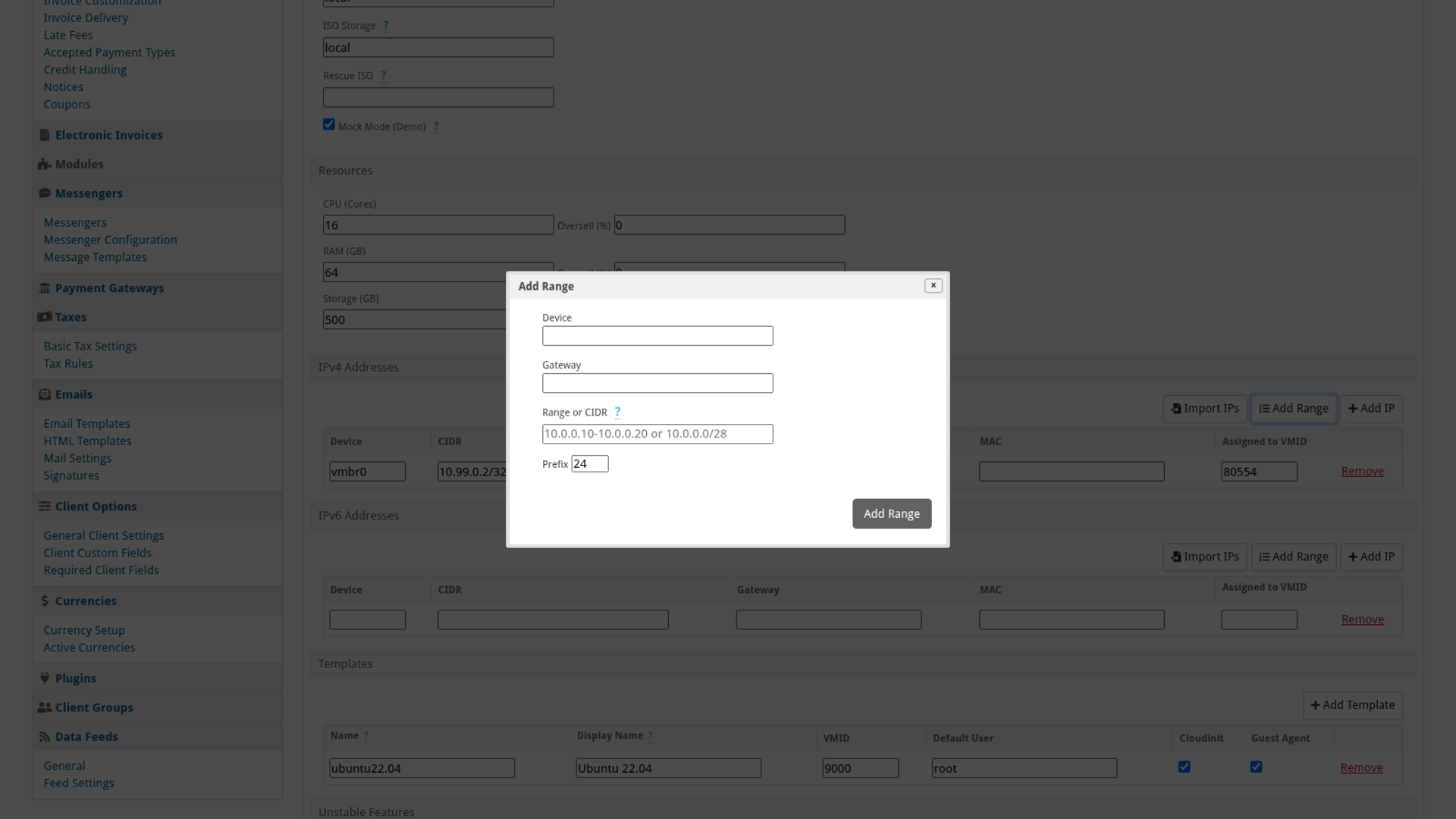
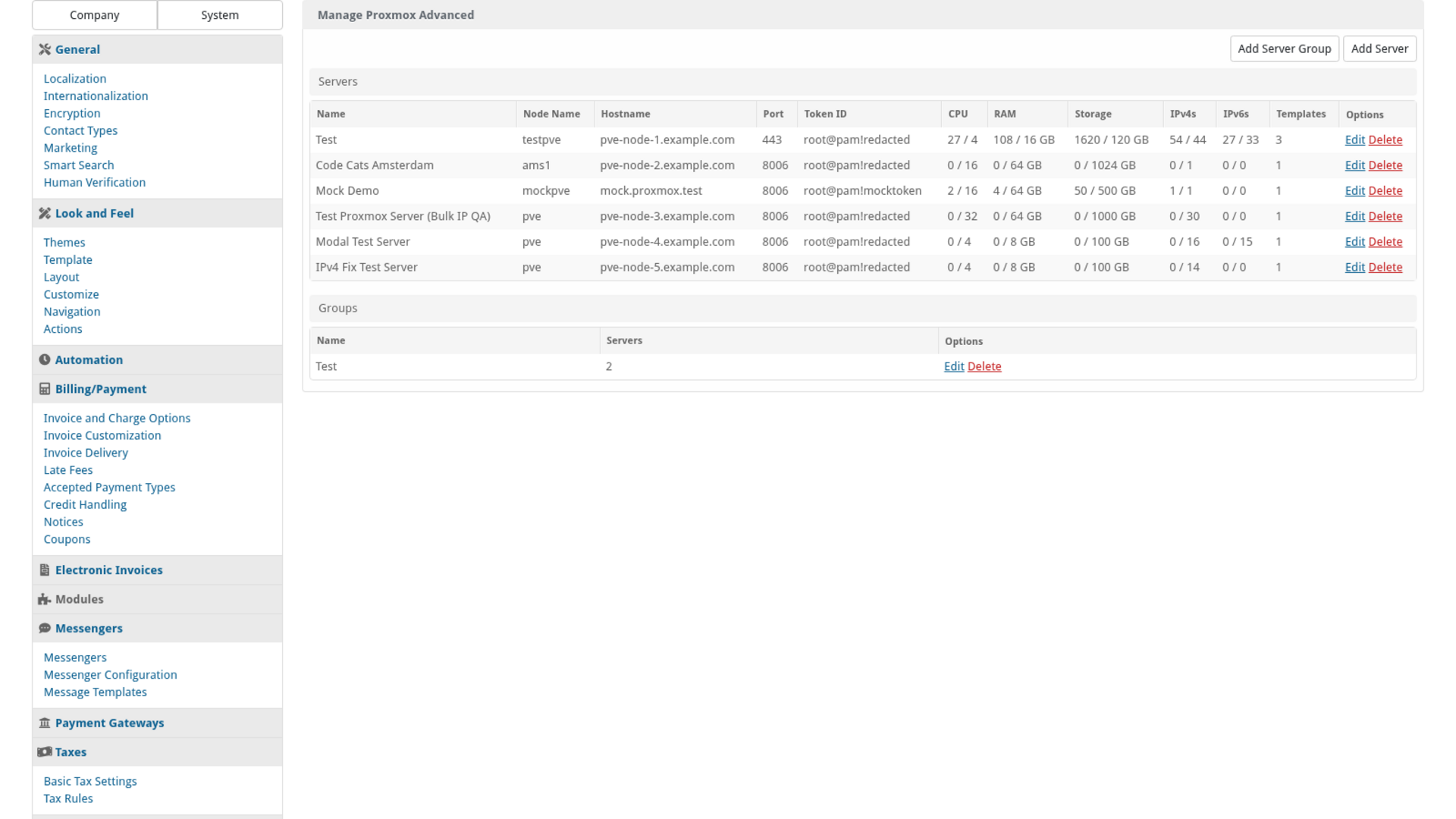
Go to Settings > Company > Modules, click Manage next to Proxmox Advanced, then Add Server. Give the server a name, its node, hostname/IP and port, an API token, the storage locations to use for VM disks, backups and ISOs, and the node's CPU, RAM and storage capacity (each with an optional oversell percentage). Add the IPv4 and IPv6 addresses available on the node one at a time, or use the Add Range / Import IPs tools next to the address list to add a whole CIDR block, a dash range, or a pasted list at once. List the templates clients can provision from, each shown to clients under a display name you choose. Tick Console Enabled and enter an admin username and password if you want clients to have browser console access, and set a Rescue ISO if you want the Rescue tab available on this server's services.
The Manage Proxmox Advanced page lists every server and group you've added, with a pencil (Edit) and a trash (Delete) button for each; deleting asks for confirmation first. Editing a server reopens the same form, pre-filled, with the same bulk IP tools available, and a Back button on both forms returns you to the list.
Setting up a package
On a package's Module tab (after selecting Proxmox Advanced as its module and choosing a server or group), set the plan's CPU cores, RAM, disk size, port speed, bandwidth allowance and how it's counted (inbound, outbound, or both), the action to take when it's exceeded (suspend, throttle to a speed you set, or take no action), how many snapshot and backup slots are included, how many IPv4 and IPv6 addresses to assign, how many extra volumes a client may attach and their maximum size, whether new servers power on automatically, an optional bandwidth warning threshold, and whether bandwidth resets on the calendar month or the service's own renewal date. Any of these can also be exposed as a Blesta configurable option, so clients can choose their own resource levels at checkout.
Viewing a client's server details
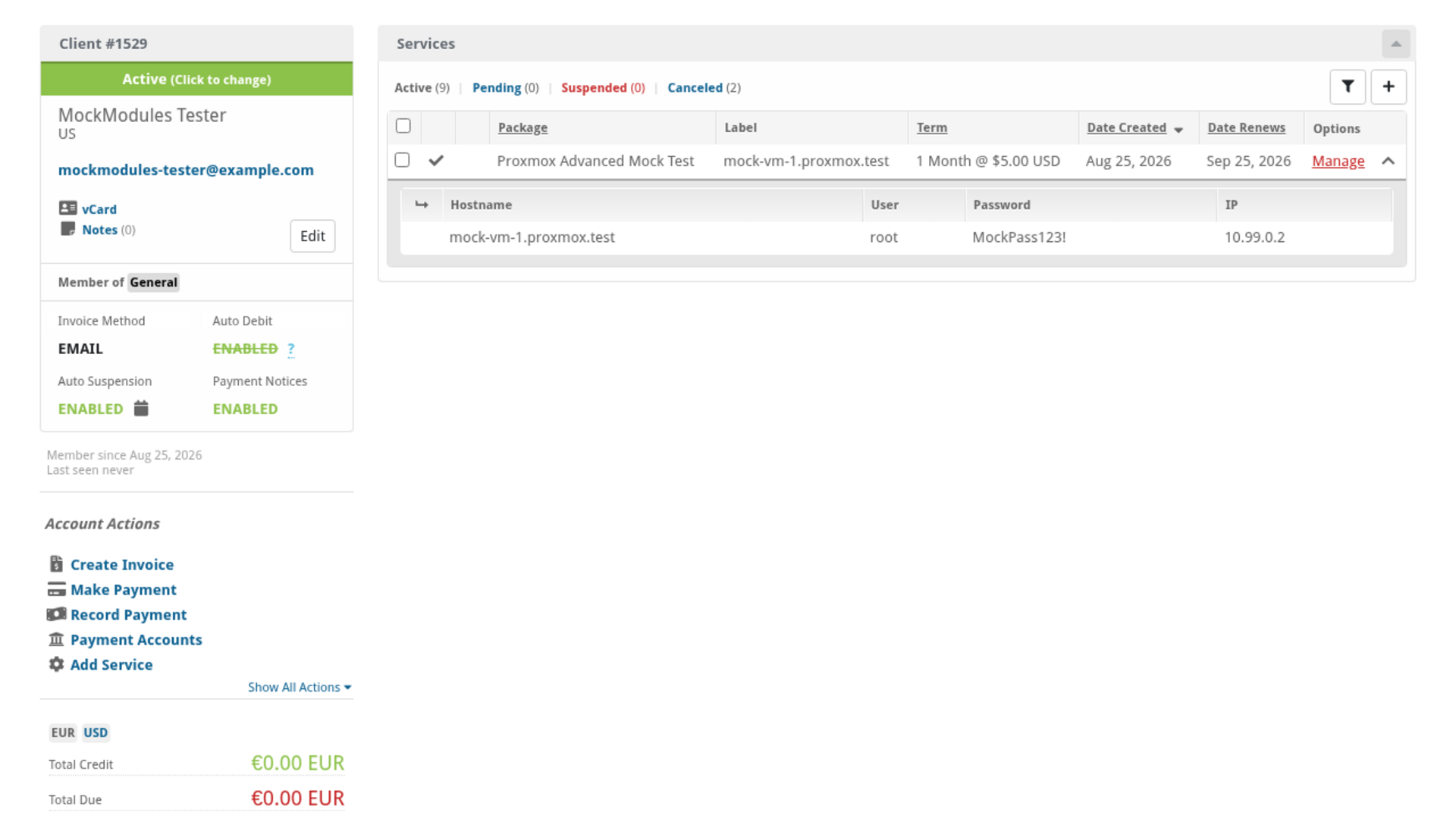
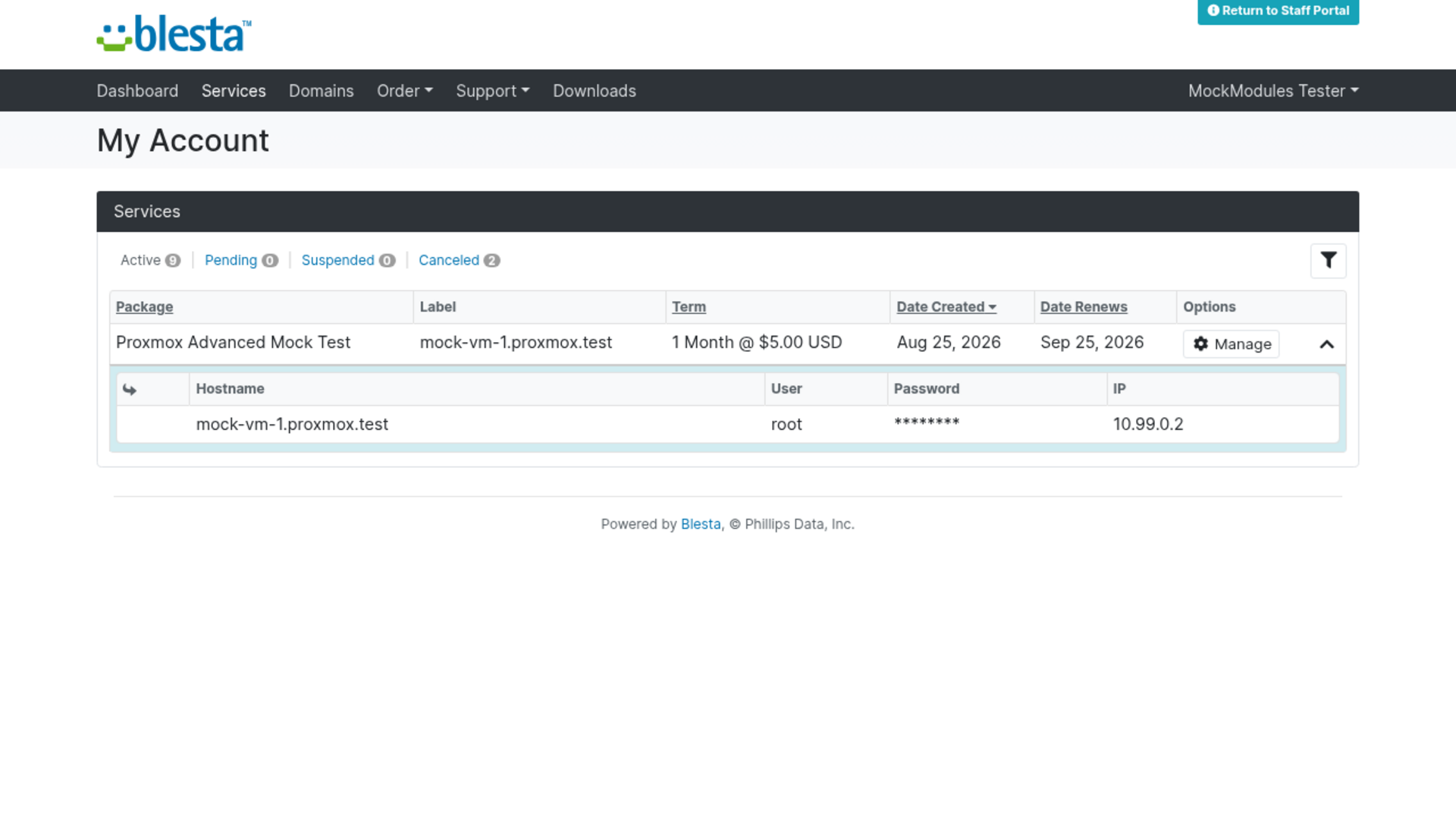
A service's admin page shows the module's own summary panel: hostname, login user, password, and assigned IP address, so you can reference the server's access details without opening a client's own view.
For your clients
Ordering a server
At checkout, clients can optionally set a hostname and paste one or more SSH keys to have installed on the server right away, alongside the plan's own term and price. Leaving either blank is fine; a hostname is generated automatically and SSH keys can always be added later from the SSH Keys tab.
Manage
The default tab. A status header shows the server's current power state alongside live CPU, memory, storage and transfer figures, with soft (shutdown/reboot) and hard (stop/reset) power controls.
Reinstall
Clients pick from the templates you've published and rebuild the server from a clean image, keeping the same IP addresses.
Backups
Clients create a backup at any time, up to the number your package allows, and restore or delete an existing one. If you enabled automatic backups, they can also switch on a daily, weekly or monthly schedule, with the oldest backup rolled off once the limit is reached.
Snapshots
Instant, named snapshots with an optional description. Clients restore or delete a snapshot in one click, up to the package's snapshot allowance.
Console
Opens a browser-based console session on the server, with a pop-out option for full-screen work - no separate software needed.
Networking
Shows the IPv4 and IPv6 addresses assigned to the server, their device and gateway, and transfer figures.
Firewall
Clients build firewall rules by direction, action, protocol, and port or ICMP type, picked from readable named lists, or apply one of the predefined rule groups you've configured. Inbound and outbound policy can also be set from the same tab.
ISO Images
Clients mount an ISO from the images you've published on the server's ISO storage, and unmount it again, useful for their own installs or recovery work.
Volumes
Clients attach additional disks up to the number and size your package allows, and detach one when it's no longer needed.
Rescue
Only shown on servers where you've set a Rescue ISO. Clients boot into it to recover a server that won't start normally, then boot back to the installed system when they're done.
SSH Keys
Clients add, edit and remove the SSH keys installed on the server, in addition to any key supplied at order time.
Activity Log
A paginated history of the tasks run against the server (provisioning, resizes, backups, and more), so clients and your support team can see what happened and when.
Good to know
- A Mock Mode (Demo) server lets you (or a prospective client) try every tab and action with no real Proxmox node or credentials - every response comes from built-in sample data.
- Backups, Snapshots, and Volumes tabs are hidden on a service whose package doesn't include them; the Console tab needs console access enabled on the server, and the Rescue tab needs a Rescue ISO set on the server.
v3.0.0 - 2026-09-29
PHP 8.2 - 8.4 · Blesta 6.x
Added support for Blesta 6. This version requires Blesta 6.0 or later; Blesta 5 installs should stay on version 2.x
Updated the server list, the add and edit server forms (including the Add Range and Import IPs tools), the staff service info panel and the package Module tab fields to the Blesta 6 admin theme, including dark mode
Changed the Edit and Delete links on the server and group lists to buttons, added a Back button to the add and edit server forms, and grouped the short server form fields two per row
Fixed four package field labels (Port Speed, Bandwidth Limit Mode, Throttle Speed, Bandwidth Count Direction) not focusing their field when clicked
Fixed a typo in the template Name tooltip on the server form
v2.0.0 - 2026-09-11
PHP 7.2 - 7.4, 8.1 - 8.4 · Blesta 5.x
Added "Add Range" and "Import IPs" modal tools to the Add/Edit Server IPv4 and IPv6 tables, so a whole CIDR block, dash range, or pasted list of addresses can be added at once instead of one row at a time
Added a "Power on after provisioning" package option; VMs now boot after provisioning and reinstall, and reboot to apply changes after a service edit or plan change
Added hostname rename sync so editing a service's hostname renames the VM in Proxmox
Added console session cleanup: the per-service Proxmox access user and ACL are removed on suspension and cancellation
Added an optional per-package bandwidth usage warning email, sent once per cycle when usage crosses a configurable threshold
Added automatic-backup failure surfacing: every outcome is logged and repeated failures are flagged in the module log
Added capacity-aware group ordering; full servers are skipped and ordering errors clearly when every server in a group is full
Added a per-package bandwidth reset window (calendar month or service anniversary)
Added pagination to the Activity Log tab
Added a default welcome email template for the module
Added a Volumes tab to attach, resize and detach additional disks, quota'd by new package options
Added a Rescue tab to boot a server from a configurable rescue ISO and back
Fixed a client being able to bind a new order to a virtual machine they do not own by submitting a VMID with the order form, which then gave them power, reinstall, firewall and disk control over another customer's server; a VMID is now accepted only from the staff server form, and never one that already belongs to another service
Fixed automatic backups running every night for every server whose backup schedule was set to "None", each run deleting the client's own oldest backup once the package limit was reached
Fixed SSH keys supplied at order time being written to the server in a form Proxmox cannot read, so the key never worked and the client could not log in
Fixed the monthly bandwidth reset rewriting fields on cancelled services
Fixed {package.storage} rendering blank in welcome emails; the disk size is now available as {package.disk}
Fixed a failed API call reporting no error at all when the server's reply carried no status text, which made the action look successful
Fixed a stray character trailing the API error messages shown to clients
Fixed the console login reporting success when Proxmox returned a reply it could not read
Fixed a text-type configurable option value being dropped when overriding package meta
Fixed every module upgrade adding another copy of the bandwidth cron tasks, which counted the same traffic several times over and could throttle or suspend a client early; existing duplicates are removed on upgrade
Fixed disk resizes identifying the wrong disk on a server with more than one drive
Fixed a throttled server never returning to full speed after its usage fell back within the allowance
Fixed a service tab hanging, and eventually timing out, when its node is unreachable; refresh requests no longer stack up and API calls give up sooner
Fixed the firewall inbound and outbound policy selectors saving without the usual form protection and without confirming the result
Fixed the firewall rule delete button never removing a rule; the trash icon ignored the first click and confirming did nothing, so it now opens its confirmation straight away and deletes through the same protected form the other rule actions use
Fixed the console password being derived from a predictable value instead of being fully random
Fixed a service with no virtual machine listing every unassigned IP address in the server's pool as its own
Fixed bandwidth usage no longer being recorded once the allowance is reached when the limit action is set to none
Fixed a server whose throttle speed equals its port speed being treated as permanently throttled, which silently stopped its bandwidth metering
Fixed the Enable Console checkbox on the Add and Edit Server forms dropping below its label
Fixed the Edit Server form not stating that a blank password field keeps the stored value
Fixed the snapshot list ordering inconsistently
Fixed a blank status label on the service overview when the node cannot be reached
Fixed PHP warnings raised on failure paths when the Proxmox API returns no data
Fixed the Proxmox login ticket and CSRF token being written to the module log in plain text every time a console session was opened, which handed a working Proxmox session to anyone able to read the logs
Fixed the firewall rule form submitting a leftover protocol and ICMP type alongside a chosen macro, which could apply a different rule than the one selected
Fixed a timing window where two servers being provisioned at the same time could be assigned the same IP address with no ownership check to catch it
Fixed a server resize leaving its firewall address list pointing at the old IP when the update that followed it failed
Fixed several numeric server and service fields accepting values that should have been rejected, due to an incorrectly written validation pattern
Fixed the client order and edit forms crashing with an error page when a virtual machine ID was submitted in an unexpected format
Fixed a bandwidth-suspended service having its usage figures discarded instead of saved the moment it was restored, which could let that usage be counted twice on the next check
Fixed two templates sharing the same name on a server going unvalidated, which could let the wrong template be selected at order time
Fixed editing or deleting an SSH key that no longer matched the server's current keys failing silently instead of showing an error
v1.3.0 - 2025-10-27
PHP 7.2 - 7.3, 8.1 - 8.4 · Blesta 5.x
Changed default backup mode from suspend to snapshot
Changed Admin Password and Token Secret fields to passwords (not filled in on edits)
Added Automatic Backup feature
Added SSH key support
Added API request logging
Improved Firewall Rule Add/Edit UI
Fixed not being able to remove servers from the module settings
Fixed boot order not being set when mounting ISOs
Fixed Firewall "Security Groups" being editable by, and displayed to clients
Fixed Oversell settings not being applied
Fixed VMs not releasing IPv6 addresses on cancellation
Fixed cron tasks breaking when active Proxmox service count exceeds Blesta pagination
Fixed VM reinstalls not functioning properly on high server-count nodes when providing a template configurable option
Minor Snapshots UI Fixes
Removed QEMU Status API logs from Tools > Logs > Modules
Update sponsored by
https://enzonix.com/
v1.2.0 - 2025-06-13
PHP 7.2 - 7.3, 8.1 - 8.4 · Blesta 5.x
Added default user configuration per OS - As some OS, like Windows, uses Administrator for Cloudinit instead of root
Added configurable bandwidth throttle speeds
Added configurable port speed per package
Added 'bandwidth_limit_speed', 'bandwidth_limit_mode', 'bandwidth_count_direction' and 'port_speed' to configurable options
Fixed module server table widths for IPv4, IPv6 and Templates
Fixed package fields not loading until triggered by a server/server group change in certain situations
Clarified error messages
v1.1.2 - 2025-03-02
PHP 7.2 - 7.3, 8.1 - 8.4 · Blesta 5.x
Fixed console URL validation
v1.1.1 - 2025-02-02
PHP 7.2 - 7.3, 8.1 - 8.4 · Blesta 5.x
Improved console reliability
v1.1.0 - 2025-01-29
PHP 7.2 - 7.3, 8.1 - 8.4 · Blesta 5.x
Reimplemented reinstall
- Simplified - In-place reinstall, without VMID changes
- Fixed reinstall IP assignment and Cloudinit issues
- Fixed Backups & Snapshot assignment on reinstall
Fixed service editing causing errors
Fixed server overview displaying wrong RAM usage
v1.0.3 - 2025-01-28
PHP 7.2 - 7.3, 8.1 - 8.4 · Blesta 5.x
Fixed IPv6 gateway configuration typo
v1.0.2 - 2025-01-27
PHP 7.2 - 7.3, 8.1 - 8.4 · Blesta 5.x
Fixed API requests not respecting `Blesta.curl_verify_ssl` setting
v1.0.1 - 2025-01-26
PHP 7.2 - 7.3, 8.1 - 8.4 · Blesta 5.x
Fixed IPv6 validation
Fixed console not working when port is not 443
v1.0.0 - 2025-01-20
PHP 7.2 - 7.3, 8.1 - 8.4 · Blesta 5.x
Initial version
Pricing Options
Get exactly what you need and want.
Requires PHP 8.2 - 8.4 · Blesta 6.x
Included In
Value: £65.55
- +58 Other Extensions
- Additional Discounts
- Included Support & Updates
Leased
- Partially Encoded
- Full Functionality
- Included Support & Updates
Owned
- Partially Encoded
- Buy Once Use Forever
- 1 Year Support & Updates
Owned - Source
- Source Available
- Buy Once Use Forever
- 1 Year Support & Updates
Not sure whether to lease or own? Our FAQ explains how the licence types differ.
Reviews
What our customers say
(0 customer reviews)
Seems like this extension doesn't have reviews yet...
Be one of the firsts to leave a review!
It is possible to leave a review only if you have purchased this extension or a Club tier which contains it.
We reserve the right to alter wording or formatting for presentation.
We will discuss any changes made and offer the option to withdraw review text if the changes can't be agreed on.
It may take up to 1 hour for a review to appear or update due to caching.
You might also like
More extensions to explore

Module
BunnyDNS
Integrate BunnyDNS for automatic DNS provisioning and management.
PHP 8.2 - 8.4 · Blesta 6.x

Module
Cloudmini
Integrate Cloudmini for automatic cloud hosting provisioning.
PHP 7.2 - 7.4, 8.1 - 8.4 · Blesta 5.x

Module
Convoy Panel
Provision servers using Convoy, a Proxmox based VPS management panel
PHP 8.2 - 8.4 · Blesta 6.x

Module
Datalix
Integrate Datalix module into your Blesta install to provision VPS servers.
PHP 8.2 - 8.4 · Blesta 6.x

Module
Enhance
Integrate Enhance for automatic provisioning and management.
PHP 8.2 - 8.4 · Blesta 6.x

Module
Hetzner Cloud
Integrate Hetzner Cloud for automatic server provisioning.
PHP 8.2 - 8.4 · Blesta 6.x